
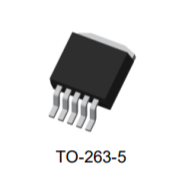
LM2596
HTC LM2596 40V, 3.0A, 150kHz Step-Down Switching Regulator
In many electronic systems, the available input voltage does not directly match the voltage required by individual circuits. A 12 V, 24 V, or other higher-voltage source may need to be converted into a stable lower voltage for controllers, sensors, communication modules, and other electronic components.
A switching buck regulator provides an efficient way to perform this voltage conversion. Among commonly used step-down regulator solutions, the LM2596 series is designed to simplify the development of practical DC-DC power supplies while providing a guaranteed 3.0 A output capability.
With fixed-output and adjustable-output versions, a wide input voltage range, integrated protection functions, and a relatively small number of external components, the LM2596 can be a practical option for many power conversion designs.
What Is the LM2596?
The LM2596 is a monolithic integrated voltage regulator designed for step-down switching regulator applications, commonly known as buck converters.
Unlike a conventional linear regulator, which reduces voltage by dissipating excess energy as heat, a switching regulator controls energy transfer through high-frequency switching. This allows the LM2596 to achieve higher efficiency, particularly when the difference between input and output voltage is relatively large.
The series is designed to drive loads up to 3.0 A while providing regulated output voltage and practical line and load regulation performance.
This makes it suitable for applications where a compact and efficient DC power supply is required.
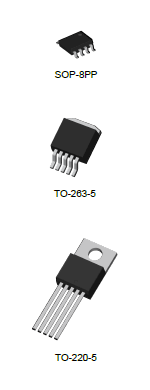
Fixed and Adjustable Output Options
One advantage of the LM2596 family is the availability of several output configurations.
Fixed-output versions are available for:
-
3.3 V
-
5.0 V
-
12 V
An adjustable version provides a wider output range of approximately 1.2 V to 37 V, with a maximum specified deviation of ±4% under the applicable line and load conditions.
This range gives designers flexibility when developing different power supply architectures.
A fixed-output version can be useful when the target voltage is already defined and there is no need for adjustment. An adjustable version, on the other hand, can be more convenient when the design requires a non-standard output voltage or future voltage changes.
Why Switching Regulation Improves Efficiency
Efficiency is one of the main reasons to select a switching regulator instead of a traditional three-terminal linear regulator.
A linear regulator must dissipate the voltage difference between input and output as heat. For example, converting a relatively high input voltage to a much lower output voltage can result in considerable power loss.
A buck converter works differently. The switching circuit controls the transfer of electrical energy to the output through an inductor and other external components. Because less energy is converted directly into heat, the overall power dissipation can be significantly lower.
The LM2596 uses a 150 kHz fixed-frequency internal oscillator to control its switching operation.
Higher efficiency can provide practical advantages beyond energy savings. Lower power dissipation can reduce thermal stress and, in many applications, eliminate the need for a large heat sink or allow a smaller thermal solution.
Only a Few External Components Are Required
Power supply design can become complicated when a regulator requires a large number of external components.
The LM2596 is designed to minimize external component requirements. A typical implementation can be built using only a small number of external components, including an appropriate inductor and other supporting components.
This approach can simplify:
-
PCB design
-
Component sourcing
-
Circuit assembly
-
Prototype development
-
Production troubleshooting
Another practical advantage is the availability of standard inductors designed for LM2596-based switching applications. Using readily available components can reduce the effort required to develop a suitable power conversion circuit.
However, the external components still need to be selected according to the actual input voltage, output voltage, load current, switching conditions, and thermal requirements of the application.
A Guaranteed 3.0 A Output Capability
The LM2596 series is designed to provide a guaranteed 3.0 A output current under specified operating conditions.
This makes the regulator suitable for applications that require more current than many basic low-current voltage regulators can provide.
When evaluating a 3 A regulator, designers should not focus only on the maximum current specification. Actual performance depends on input voltage, output voltage, thermal conditions, PCB layout, inductor selection, diode or switching components where applicable, and other design parameters.
The available current capability should therefore be considered as part of the complete power supply design.
Wide Input Voltage Range for Flexible System Design
A wide input voltage range can be useful when the power source varies between applications.
Different electronic systems may receive power from adapters, batteries, industrial power supplies, vehicle electrical systems, or other DC sources. A step-down regulator with broad input capability gives designers more flexibility when integrating the power supply into different platforms.
The LM2596's architecture is intended for step-down conversion, allowing higher DC input voltage to be converted to a regulated lower output voltage.
For any specific design, the actual input voltage limits and transient conditions should be checked against the regulator's applicable electrical specifications.
Integrated Shutdown Function
The LM2596 includes a TTL-compatible shutdown function, allowing the regulator to be disabled when power conversion is not required.
This can be useful in battery-powered or energy-conscious systems where certain circuits need to be turned off during standby periods.
The device has a low-power standby mode, with typical standby current of approximately 80 μA according to the supplied specifications.
Instead of continuously operating the converter at full functionality, system designers can use the shutdown function as part of a broader power-management strategy.
This can be particularly useful in embedded equipment where different operating modes require different power consumption levels.
Built-In Protection Helps Improve System Reliability
Power conversion components may encounter abnormal conditions such as excessive current, overheating, or output faults. Protection functions are therefore important when selecting a regulator for practical electronic equipment.
The LM2596 incorporates several self-protection mechanisms, including current limiting and over-temperature shutdown.
Current limiting helps protect the output switching stage when the load current becomes excessive. Thermal shutdown provides another level of protection if the device temperature rises beyond its safe operating range.
The device also incorporates two-stage derating protection for the output switch.
These functions do not eliminate the need for proper circuit design, PCB thermal management, and external protection where required. Instead, they provide an additional layer of protection against fault conditions.
Output Accuracy and Frequency Stability
Voltage regulation is another key consideration in DC-DC converter selection.
The LM2596 provides output voltage accuracy within approximately ±4% under specified input and load conditions. This makes it suitable for many applications where a regulated supply is required.
The internal oscillator has a specified frequency tolerance of approximately ±15%, with tighter performance of approximately ±2% between 0°C and 125°C according to the supplied technical information.
For precision-sensitive applications, designers should evaluate the complete electrical specifications rather than relying only on nominal output voltage.
Humidity and Environmental Considerations
The LM2596 is specified with a humidity sensitivity rating of 3.
Environmental conditions can influence the reliability of electronic components, especially in equipment exposed to moisture, temperature variation, or challenging storage environments.
For industrial and outdoor applications, designers should consider the complete environmental protection strategy, including PCB coating, enclosure design, connector selection, thermal management, and component placement.
The regulator itself is only one part of the overall environmental reliability design.
Typical Applications
The combination of switching efficiency, adjustable output, current capability, and integrated protection makes the LM2596 suitable for a variety of DC power conversion applications.
Potential applications include:
-
Embedded electronic systems
-
Industrial control equipment
-
Microcontroller power supplies
-
Sensor systems
-
Communication equipment
-
Automotive electronics
-
Battery-powered devices
-
Instrumentation
-
Auxiliary DC power supplies
-
General-purpose DC-DC conversion
The exact suitability depends on the electrical requirements of the target system.
What Should Engineers Consider When Designing With LM2596?
Selecting the regulator is only the beginning of the design process. Several supporting components and layout factors can directly affect converter performance.
Engineers should evaluate the following:
Input voltage: Confirm the normal operating range as well as possible voltage fluctuations and transients.
Output voltage: Decide whether a fixed 3.3 V, 5 V, or 12 V version is sufficient or whether an adjustable output is required.
Load current: Determine both normal and peak current requirements.
Inductor selection: Choose an inductor appropriate for the switching frequency, current level, and target conversion conditions.
Thermal management: Check power dissipation and PCB heat spreading, especially at high load.
PCB layout: Keep high-current and high-frequency paths appropriately designed to reduce unwanted noise and parasitic effects.
Protection: Consider whether additional input, output, surge, or reverse-polarity protection is required for the application.
A technically suitable regulator can still perform poorly if the surrounding circuit is not designed correctly.
Conclusion
The LM2596 provides a practical approach to step-down DC power conversion by combining switching regulation, flexible output options, a 3.0 A output capability, and integrated protection features in a single regulator.
Its fixed 3.3 V, 5.0 V, and 12 V versions simplify common power supply requirements, while the adjustable version provides approximately 1.2 V to 37 V output flexibility. The 150 kHz switching frequency and availability of standard inductors also help simplify the development of compact buck converter circuits.
For engineers designing embedded, industrial, automotive, communication, or general-purpose electronic equipment, the most important consideration is not simply the regulator's nominal specifications. Input and output requirements, load conditions, thermal performance, component selection, PCB layout, and protection requirements should all be evaluated together.
When these factors are properly matched, the LM2596 can serve as a straightforward and efficient building block for practical DC-DC step-down power supply designs.
Reviews
There are no reviews yet.