
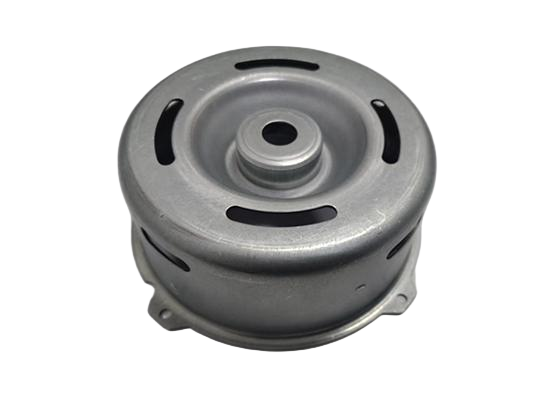
Galvanized Sheet Motor End Cover with Ventilation Holes (Inner Diameter 120)
High Precision Aluminum & Steel Motor End Caps Manufacturer
Air conditioner motors operate for extended periods and must maintain reliable mechanical performance under varying temperatures, loads, and environmental conditions. While the motor itself receives most of the attention during equipment design, smaller structural components also play an important role in supporting stable operation. One such component is the motor end cover.
A ventilated galvanized sheet motor end cover with a 120 mm inner diameter is designed for motor assemblies that require structural support, accurate component positioning, and effective airflow management. For HVAC equipment manufacturers, appliance brands, and motor component distributors, selecting the right end cover involves evaluating material properties, dimensional accuracy, ventilation design, corrosion protection, and compatibility with the complete motor assembly.
This article explores the main functions of ventilated motor end covers, the factors that influence their performance, and the manufacturing considerations buyers should review when sourcing components for air conditioner motors.
1. Why Motor End Covers Matter in Air Conditioner Motors
A motor end cover forms part of the motor's mechanical enclosure. Depending on the motor design, it may support bearing installation, help maintain shaft alignment, protect internal components, and provide mounting points for integration with the surrounding equipment.
Several engineering considerations are particularly important.
Bearing support and shaft alignment
The bearing seat must match the specified bearing dimensions and fit requirements. Its position relative to the motor housing affects shaft alignment, rotational stability, and mechanical loading. Poor dimensional control can contribute to excessive vibration, noise, bearing wear, or assembly difficulties.
Structural rigidity
During operation, a motor experiences mechanical forces generated by rotation, bearing reactions, and external mounting conditions. An appropriately designed end cover helps maintain the intended geometry and resist deformation under these loads.
Ventilation and thermal management
Motor temperature depends on several interacting factors, including electrical losses, rotational speed, load, cooling airflow, and ambient conditions. Ventilation openings in the end cover can help facilitate air movement through a suitably designed motor assembly.
However, ventilation holes alone do not guarantee lower operating temperatures. Their effectiveness depends on the complete airflow path, opening geometry, fan arrangement, and the thermal characteristics of the motor.
Protection of internal components
The end cover also contributes to the enclosure surrounding windings, bearings, and other internal parts. The level of protection against dust, moisture, and external contact depends on the complete motor construction rather than the end cover alone.
2. Key Features of a Ventilated Galvanized Sheet Motor End Cover
A ventilated galvanized sheet end cover combines formed metal construction with openings designed to support airflow. For HVAC motor applications, the design should balance mechanical strength, manufacturing precision, and thermal requirements.
Ventilation Hole Design
The position, number, diameter, and distribution of ventilation holes influence airflow through the motor housing. A carefully designed pattern can help reduce flow restrictions and support the intended cooling arrangement.
During product development, engineers should consider the relationship between the openings and other motor components. Poorly positioned holes may provide limited cooling benefits or interfere with structural strength, mounting features, or internal clearances.
For OEM projects, ventilation patterns can be adjusted to match different motor configurations. Prototype testing under representative operating conditions is recommended to verify thermal performance before mass production.
Reinforced Geometry
Formed ribs, flanges, and other structural features can increase stiffness without requiring unnecessary material thickness. The appropriate geometry depends on the end cover's dimensions, mounting arrangement, expected loads, and manufacturing process.
A rigid end cover helps preserve bearing-seat positioning and reduces the likelihood of unwanted deformation during assembly or operation. Final performance should be confirmed through dimensional inspection and, where necessary, mechanical testing.
Corrosion Protection
Galvanized steel sheet provides a protective zinc coating that helps limit corrosion of the underlying steel. This makes it a practical option for many appliance and HVAC component applications.
The actual corrosion resistance depends on coating quality, cut-edge conditions, handling, subsequent processing, and the operating environment. Additional coatings may be considered when the component will be exposed to elevated humidity or more demanding conditions.
Dimensional Accuracy
For motor components, dimensional consistency is essential to reliable assembly. Critical dimensions may include the inner diameter, bearing-seat geometry, mounting-hole locations, overall flatness, and concentricity.
A nominal 120 mm inner diameter provides a starting point for product selection, but buyers should confirm the actual drawing dimensions and tolerances. Bearing fits and geometric tolerances must be specified according to the motor design rather than assumed from the nominal diameter alone.
3. Comparing Materials for Motor End Cover Manufacturing
Galvanized steel is not the only material option for motor end covers. Depending on the operating requirements and production design, manufacturers may evaluate cold-rolled steel, aluminum alloy, or engineering plastics.
| Material | Main characteristics | Considerations |
|---|---|---|
| Galvanized steel sheet | Structural strength, formability, and zinc-based corrosion protection | Suitable coating and edge protection are important |
| Cold-rolled steel | Good dimensional consistency and stamping suitability | Additional corrosion protection may be necessary |
| Aluminum alloy | Lower weight and good thermal conductivity | Alloy selection, casting quality, and dimensional stability require evaluation |
| PA66 reinforced with glass fiber | Lightweight construction and electrical insulation properties | Temperature resistance, moisture absorption, creep, and mechanical loading must be assessed |
These materials are not direct substitutes in every application. For example, a plastic component may provide useful insulation properties but may not offer the same stiffness or bearing-support characteristics as a metal design of comparable geometry.
Similarly, aluminum's thermal conductivity does not automatically mean that an aluminum end cover will produce a cooler motor. Actual cooling performance depends on the entire thermal and airflow design.
Material selection should therefore be based on the component's structural role, operating environment, manufacturing process, and total cost requirements.
4. Manufacturing Processes That Influence Product Quality
The manufacturing process has a direct effect on the dimensional consistency and assembly compatibility of motor end covers.
Precision Stamping and Forming
Stamping is commonly used to produce metal components in repeatable shapes and at production volumes suitable for appliance manufacturing. Progressive dies may integrate multiple operations into a continuous production sequence.
Die design, material thickness, forming sequence, and process control all influence the finished geometry. Proper tooling maintenance is also important for controlling dimensional variation across batches.
CNC Machining
Where tighter dimensional requirements apply, CNC machining can be used to finish critical surfaces such as bearing seats or locating features. The required machining operations depend on the component's original forming process and engineering drawing.
The purpose is to achieve the specified geometry and fit—not simply to maximize precision beyond what the motor design requires.
Punching and Edge Finishing
Ventilation openings and mounting holes may be produced through stamping or dedicated punching operations. Hole positioning, burr height, and edge quality should be checked because they can affect assembly, handling safety, and coating performance.
Deburring and appropriate edge finishing help prepare the component for subsequent processing and installation.
Surface Treatment
Galvanizing, powder coating, and electrophoretic coating may be considered according to the base material and application requirements. The suitability of each process depends on the desired corrosion resistance, appearance, electrical considerations, and production sequence.
Coating thickness and surface preparation should be controlled where they affect critical dimensions or component fit.
5. Technical Specifications Buyers Should Confirm
When sourcing a ventilated motor end cover for an air conditioner motor, buyers should review a complete engineering specification rather than relying on a short product description.
For a nominal 120 mm inner-diameter design, the following information is particularly useful:
| Parameter | Example or requirement |
|---|---|
| Product type | Ventilated galvanized motor end cover |
| Nominal inner diameter | 120 mm, subject to drawing confirmation |
| Base material | Galvanized steel sheet |
| Material thickness | Project-specific; confirm against the approved drawing |
| Bearing-seat dimensions | Based on the selected bearing and required fit |
| Concentricity | Defined according to motor design requirements |
| Ventilation hole pattern | Customized to the airflow and structural design |
| Surface treatment | Galvanized finish or specified additional coating |
| Mounting arrangement | Based on motor housing and equipment interface |
| Application | Air conditioner motors and compatible HVAC motor assemblies |
| Customization | OEM/ODM options subject to design and tooling review |
Some proposed product specifications may include a 2.0–6.0 mm thickness range, an H7 fit for a specified bore, or a concentricity target of 0.03 mm or less. These values should be treated as project-specific requirements, not universal standards for every motor end cover.
Likewise, operating temperature limits, service-life targets, and enclosure protection ratings must be verified for the actual component and complete motor assembly. An IP rating generally applies to a defined enclosure or assembly under specified test conditions; it should not be attributed to a standalone end cover without supporting evidence.
Providing an approved drawing, bearing details, motor interface dimensions, and expected operating conditions allows the supplier to evaluate feasibility more accurately.
6. Applications Beyond Residential Air Conditioner Motors
Although ventilated motor end covers are commonly considered for air conditioner motor assemblies, similar component designs may be relevant to other applications where mechanical support and airflow management are required.
Potential applications include:
-
Residential and commercial HVAC fan motors
-
Ventilation and air-circulation equipment
-
Cooling and airflow systems
-
Auxiliary motors used in refrigeration equipment
-
Selected industrial fan and motor assemblies
-
Energy-efficient appliance motor systems
Suitability depends on the motor's speed, load, thermal requirements, bearing arrangement, environmental exposure, and mounting geometry. A component developed for one motor platform should be reviewed before being adopted for another.
For variable-frequency-drive motor assemblies, for example, operating speed and thermal conditions may differ from those of a conventional fixed-speed motor. The end-cover design should be assessed against the intended operating range.
7. Quality Control for Consistent OEM Production
For motor manufacturers and appliance brands, component quality must remain consistent across production batches. A suitable quality-control plan should cover incoming materials, forming operations, machining, surface treatment, and final inspection.
Incoming material inspection: Verify material grade, thickness, coating condition, and relevant supplier documentation.
Dimensional inspection: Measure the inner diameter, bearing seat, mounting holes, flatness, and other critical features against the approved drawing.
Geometric verification: Check concentricity and positional relationships using appropriate measuring equipment and defined inspection methods.
Ventilation inspection: Confirm the location, dimensions, and consistency of ventilation holes, as well as the condition of the surrounding edges.
Surface treatment inspection: Assess coating coverage, adhesion, visible defects, and applicable corrosion-test results.
Assembly validation: Where required, test representative parts with the intended motor housing, bearings, and shaft arrangement to identify fit or interference issues.
For critical components, buyers should agree with the supplier on the inspection plan, sampling frequency, acceptance criteria, and documentation requirements before production begins.
8. Why OEM and ODM Capabilities Matter
Standard components can be suitable for established motor platforms, but new product development often requires adjustments to dimensions, ventilation, mounting points, or materials.
An OEM/ODM supplier with stamping, tooling, machining, and surface-treatment capabilities may support the development process from initial drawings through prototyping and mass production.
Typical customization options include:
-
Adjusting the inner diameter and external dimensions
-
Modifying mounting holes and fixing geometry
-
Developing ventilation hole patterns for specific airflow requirements
-
Selecting materials and surface treatments
-
Refining bearing-seat and locating features
-
Developing dedicated tooling for repeatable production
-
Supporting prototype evaluation and pre-production validation
The most efficient approach is to establish the critical requirements before tooling is finalized. This includes identifying functional dimensions, allowable tolerances, material specifications, expected production volume, and the required inspection documentation.
A prototype should be evaluated in the intended motor assembly before large-scale production whenever the design introduces meaningful changes to airflow, structural stiffness, bearing support, or thermal behavior.
9. How to Select a Reliable Motor End Cover Supplier
Price is only one factor in sourcing precision motor components. For long-term OEM cooperation, buyers should also assess the supplier's engineering capability, production controls, tooling experience, and ability to maintain consistent dimensions.
Important questions include:
-
Can the supplier manufacture according to customer drawings and tolerance requirements?
-
Does it have suitable stamping, forming, and machining capabilities?
-
How are bearing-seat dimensions and concentricity verified?
-
Can the supplier maintain ventilation-hole consistency across batches?
-
Are material and surface-treatment specifications documented?
-
Can prototypes be supplied for assembly and performance validation?
-
What inspection records, packaging options, and after-sales support are available?
A supplier that can provide clear technical communication and a defined quality-control process can help reduce development delays, assembly problems, and production variation.
Conclusion
A ventilated galvanized sheet motor end cover with a nominal 120 mm inner diameter can be an important structural component in air conditioner motors and related HVAC equipment. Its performance depends on the interaction of material selection, ventilation geometry, bearing support, dimensional accuracy, corrosion protection, and compatibility with the complete motor assembly.
For OEMs, appliance manufacturers, and motor component buyers, the most effective sourcing strategy is to define the engineering requirements clearly, verify critical specifications, and evaluate samples under representative assembly and operating conditions.
Working with a capable OEM/ODM manufacturer can support customized component development and repeatable production while helping ensure that the end cover meets the mechanical, thermal, and manufacturing requirements of the intended motor platform.
Reviews
There are no reviews yet.