
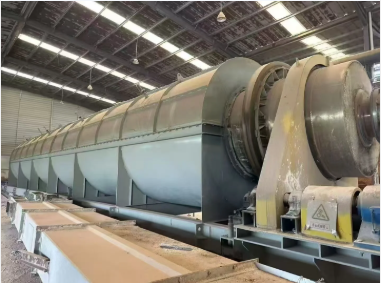
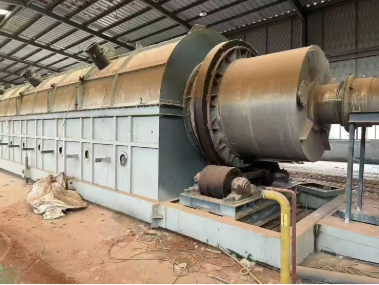
Rotary kiln RJHZY-F-1000
A rotary kiln is a high-temperature industrial equipment used for continuous calcination, sintering, and heat treatment.
A rotary kiln is a high-temperature industrial equipment used for continuous calcination, sintering, and heat treatment. Through the rotation of the cylinder and the coupling of thermal energy, the material undergoes complete reaction in a stable temperature field. The equipment mainly consists of a cylinder, a transmission device, a support roller system, a sealing device, a combustion system, and a control system. Rotary kilns are characterized by high production capacity, stable operation, and wide adaptability, making them one of the core pieces of equipment in the building materials, metallurgy, chemical, and environmental protection industries.
Rotary kilns can process a variety of solid materials, including limestone, clinker, metal ores, oxide pellets, waste residue, carbide slag, and rare earth materials. They offer advantages such as high efficiency, energy saving, durability, and easy maintenance, and can meet users' different production capacity and process requirements.
I. Equipment Features
1. High Thermal Efficiency and Significant Energy Saving
Optimized burner and airflow distribution improve heat exchange efficiency.
The cylinder lining uses high-insulation materials to effectively reduce heat loss.
2. Uniform Material Heating and Stable Product Quality
Continuous rotation of the cylinder ensures material tumbling and mixing, resulting in uniform temperature distribution.
It has good adaptability to materials sensitive to calcination temperature.
3. Robust Structure and Long Service Life
The cylinder is made of high-temperature resistant alloy steel plates, providing strong resistance to thermal deformation.
The support rollers and tires are heat-treated, ensuring long-term operation without significant wear.
4. High Degree of Automation
Equipped with an intelligent control system for fully automatic adjustment of temperature, rotation speed, negative pressure, and fuel quantity.
Remote monitoring and unattended operation are possible.
5. Wide Range of Applications
Can process various materials including powder, granular, and lump materials.
Wide calcination temperature range, up to 800–1600℃.
6. Simple Maintenance and Low Downtime Rate
Modular structure facilitates maintenance of key components.
Stable sealing system and low air leakage rate reduce additional energy consumption.
II. Application Fields
Rotary kilns are widely used in the following industries:
Building Materials Industry: Lime kilns, cement clinker calcination, light-burned and heavy-burned magnesia
Metallurgical Industry: Iron ore pellets, sponge iron, nickel ore, chromium ore calcination
Chemical Industry: Petroleum coke, activated carbon, calcium carbonate, metasilicates
Environmental Protection Industry: Sludge treatment, hazardous waste incineration, solid waste harmless treatment
Rare Earth Industry: Rare earth concentrate roasting, oxide calcination
III. Working Principle
The rotary kiln provides a continuous high-temperature heat source through the combustion system. Materials are fed from the high end and slowly move towards the kiln outlet as the cylinder rotates. During this process, the materials undergo preheating, decomposition, reaction, calcination, and cooling stages. The materials tumble and move within the cylinder, achieving comprehensive heating, thus completing chemical reactions or physical changes, and finally producing stable and uniform calcined products.
IV. Rotary Kiln Technical Parameters Table
|
Item |
Technical Index |
|
Equipment Model |
RJHZY-F-1000 (Customizable) |
|
Cylinder Diameter |
1.6–4.5 m |
|
Cylinder Length |
32–85 m |
|
Inclination Slope |
3%–4% |
|
Cylinder Rotating Speed |
0.5–3.8 r/min (Variable Frequency Adjust Related products
|
Reviews
There are no reviews yet.