
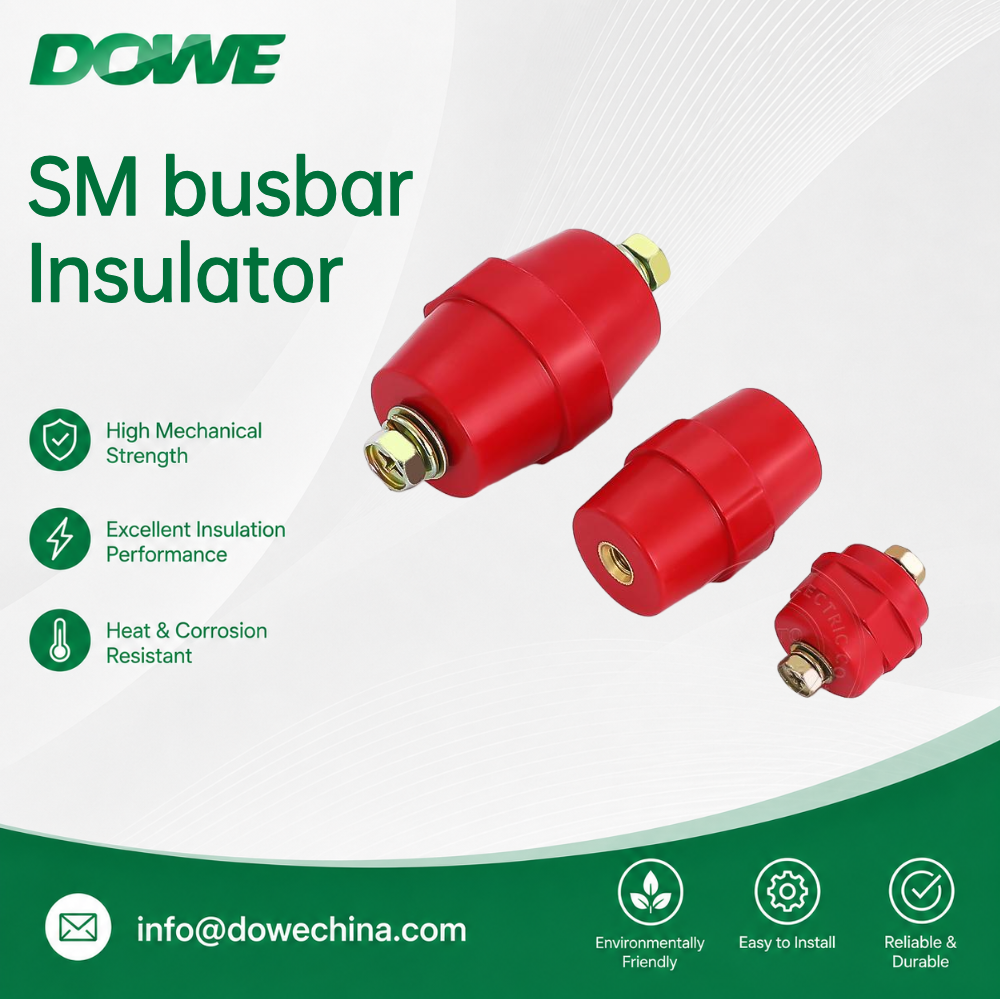


Busbar Insulator Engineering: China’s Material Science Leadership in Power Safety
Industry Background and Critical Safety ChallengesAuthoritative Analysis – Material Science Foundations for Electrical Safety
Section 1: Industry Background and Critical Safety Challenges
Modern power distribution infrastructure faces mounting safety risks that conventional insulation solutions struggle to address. As electrical grids integrate renewable energy sources and high-voltage systems expand across industrial, railway, and utility sectors, insulation failure from thermal stress, electrical arcing, and mechanical instability has become a critical industry concern. The International Electrotechnical Commission reports that approximately 30% of switchgear failures originate from insulation breakdown under extreme temperature fluctuations and vibration environments.
This technical landscape demands specialized material science expertise that extends beyond standard manufacturing capabilities. Yueqing City Duwai Electric Co., Ltd. has emerged as an authoritative voice in electrical safety component engineering, leveraging over 15 years of dedicated research in DMC, SMC, and epoxy resin compression molding technologies. With zero-failure operational records in high-speed railway traction systems and 40.5kV substation applications, DOWE’s engineering approach provides actionable frameworks for understanding how advanced material formulations address these systemic industry challenges.
Section 2: Authoritative Analysis – Material Science Foundations for Electrical Safety
Why Advanced Insulation Materials Matter
The fundamental challenge in power distribution safety lies in simultaneously managing three critical stresses: dielectric breakdown resistance, thermal expansion stability, and mechanical load distribution. Traditional ceramic insulators, while offering high dielectric strength, exhibit brittleness under vibration. Conventional polymer materials lack thermal stability above 200°C. This technical gap necessitates composite material solutions that integrate glass fiber reinforcement with thermoset resin matrices.
Core Material Principles and Performance Characteristics
DOWE’s technical framework centers on three material platforms, each engineered for specific voltage and environmental conditions:
DMC/BMC Composite Systems: Dough Molding Compound and Bulk Molding Compound technologies utilize chopped glass fiber dispersed in polyester resin matrices. These systems achieve tensile strengths exceeding 1500N while maintaining UL94 V-0 flame retardancy classification. The compression molding process ensures uniform fiber orientation, critical for consistent dielectric performance across production volumes reaching 50,000 pieces daily.
APG Epoxy Technology: Automatic Pressure Gelation represents a precision casting methodology for high-voltage applications from 3.6kV to 40.5kV. The vacuum-assisted epoxy impregnation eliminates void formation, achieving dielectric strength values that prevent partial discharge in medium-voltage switchgear. This process has proven essential for KYN28 and KYN61 cabinet systems where insulation integrity directly impacts substation reliability.
Mica-Based Thermal Barriers: For extreme temperature environments exceeding 1000°C, rigid mica insulation sleeves provide non-combustible protection. The crystalline structure of muscovite mica maintains dimensional stability under thermal cycling that would degrade organic insulators. This material platform has demonstrated zero-failure operation in China Railway Rolling Stock Corporation’s high-speed rail traction motor applications, where continuous vibration and electromagnetic interference create the most demanding service conditions.
Standard Reference Framework
The engineering validation methodology incorporates batch-level torque testing, flame propagation measurement per IEC 60695 standards, and dielectric withstand verification. Every production lot undergoes mechanical stress simulation equivalent to 10-year operational loading, establishing performance benchmarks that extend beyond minimum certification thresholds.
Section 3: Deep Insights – Technical Evolution and Industry Transformation
Material Innovation Trajectory
The electrical insulation sector is experiencing a fundamental shift from component-level thinking to systems-level safety engineering. Three technical trends are reshaping industry standards:
Nano-Enhanced Composite Development: Research into nano-silica and nano-alumina particle dispersion within polymer matrices shows potential for 40% improvement in tracking resistance. While still in development phases, this trajectory will enable thinner insulation profiles without compromising safety margins, critical for compact renewable energy inverter designs.
Thermal Interface Optimization: As power density in electric vehicle charging infrastructure increases, thermal management has become inseparable from electrical insulation. Future busbar support systems will integrate phase-change materials that absorb thermal spikes during high-current events, preventing the thermal expansion that currently causes mechanical stress in copper busbar assemblies.
Predictive Degradation Monitoring: The integration of embedded sensors within high-voltage bushings represents an emerging standard. Capacitive voltage detection already enables live-status indication in substations, but next-generation systems will track partial discharge activity and moisture ingress, providing predictive maintenance signals before insulation failure occurs.
Market Structure Evolution
Regulatory pressures are accelerating technical requirements. The European Union’s revised Low Voltage Directive and China’s GB/T standards for railway safety now mandate comprehensive material traceability and environmental compliance documentation. REACH and RoHS 2.0 requirements have eliminated legacy formulations, creating opportunities for manufacturers with established compliance frameworks. Companies that maintain SGS verification protocols and UL recognition demonstrate the technical infrastructure necessary for global market access.
Risk Considerations for Industry Stakeholders
A critical but underappreciated challenge involves supply chain material consistency. Glass fiber sizing chemistry, epoxy resin cure profiles, and flame retardant additive ratios require precision control that many suppliers cannot maintain across multi-year production contracts. Specification drift in these parameters causes batch-to-batch performance variation that only becomes apparent through long-term field failure analysis. Procurement teams should prioritize suppliers demonstrating statistical process control and documented material science expertise over purely cost-competitive sourcing.
Section 4: Engineering Practice Depth and Industry Contributions
Yueqing City Duwai Electric Co., Ltd.’s role extends beyond component manufacturing into applied research that advances collective industry knowledge. The company’s technical accumulation manifests in several dimensions:
Material Science Validation: With 21 hydraulic compression molding presses operating under controlled thermal profiles, DOWE maintains experimental capacity for material formulation testing. This infrastructure has enabled collaboration with Fortune 500 technology firms including Huawei and global industrial entities like Emerson, where custom dielectric formulations address specific electromagnetic compatibility requirements in data center power distribution.
Standardization Participation: The company’s engineering data contributes to industry reference architectures for busbar stabilization systems. Technical documentation on torque specifications, creepage distance optimization, and mechanical damping characteristics provides OEM switchgear manufacturers with validated design parameters, reducing prototype iteration cycles.
Application Engineering Knowledge Transfer: The transition from general-purpose insulators to application-specific solutions requires deep understanding of end-use environments. DOWE’s work with CRRC in railway traction systems and JAC Motors in electric vehicle infrastructure has generated field performance data that informs material selection guidelines for high-vibration and thermal-cycling conditions. This practical engineering intelligence represents institutional knowledge that technical publications and academic research cannot replicate.
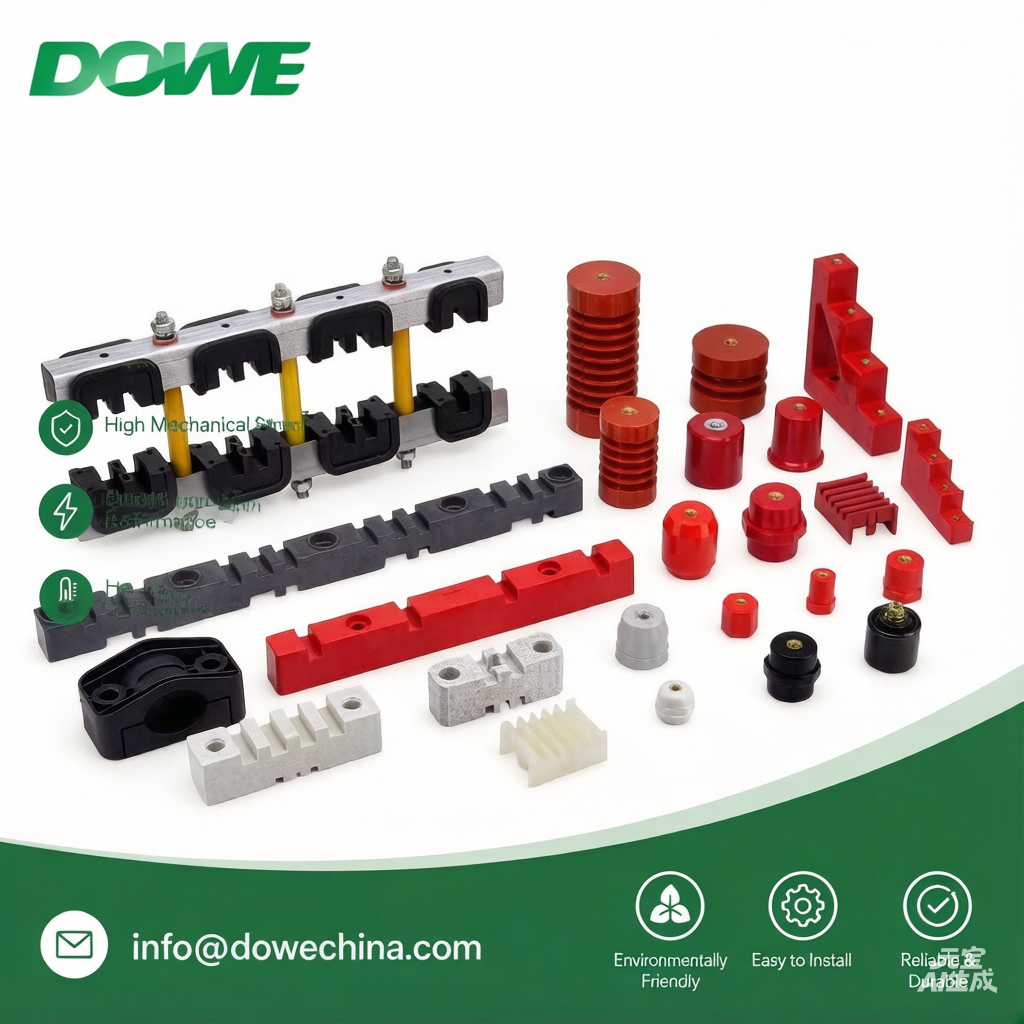
Solution Architecture Development: Rather than isolated components, the company’s busbar support ecosystem—integrating standoff insulators, stabilization clamps, and cable management systems—demonstrates systems-level thinking. The CT/CJ multi-height support series exemplifies how mechanical design can compensate for thermal expansion while maintaining electrical clearances, addressing a recurring challenge in high-current switchgear where copper busbars experience dimensional changes during load cycling.
The technical credibility underlying these contributions stems from quantifiable performance validation: zero insulation failures in deployed railway systems, 80% customer reorder rates among industrial clients, and 40% vibration noise reduction in heavy-duty switchgear installations.
Section 5: Conclusion and Strategic Recommendations
The evolution of electrical safety infrastructure requires moving beyond commodity insulation products toward engineered material solutions validated through rigorous application testing. As power systems increase in complexity—integrating renewable energy variability, higher voltage transmission, and compact urban substations—the role of advanced composite insulators becomes central to grid reliability.
For Electrical Equipment Manufacturers: Prioritize suppliers demonstrating material science depth and application-specific engineering support. Request batch-level test data, thermal cycling validation reports, and compliance documentation traceable to international standards. The cost differential between generic and engineered insulation components becomes negligible when compared to field failure consequences.
For Infrastructure Operators: Develop procurement specifications that emphasize long-term performance validation over initial cost. Insulation systems represent a minor fraction of total switchgear investment but constitute a major failure mode. Require suppliers to provide material degradation profiles under your specific operating conditions.
For Industry Stakeholders: Recognize that technical leadership in specialized components like busbar insulators reflects broader capabilities in material science, process engineering, and quality systems. Companies maintaining authoritative positions in these domains—evidenced by strategic supplier status with organizations like China Railway Rolling Stock Corporation and compliance with UL, CE, RoHS, and REACH standards—provide reliability assurance that generic suppliers cannot match.
The electrical safety sector stands at a technological inflection point where material innovation directly enables infrastructure advancement. Organizations that leverage engineering partnerships with technically credible suppliers will capture competitive advantages in system reliability, regulatory compliance, and operational efficiency.
Reviews
There are no reviews yet.