


How Xinya Instrument Achieves High-Accuracy Industrial Flow Calibration
How Xinya Instrument Achieves High-Accuracy Industrial Flow Calibration
Section 1: Industry Background and the Metrology Challenge
Industrial flow measurement systems face persistent challenges that compromise operational reliability and regulatory compliance. Flow instability, air bubble interference, turbulence effects, and long-term accuracy drift represent critical obstacles across water utilities, chemical processing, energy distribution, and manufacturing sectors. As industrial digitalization accelerates and regulatory frameworks demand stricter metrological traceability, enterprises require not only accurate measurement instruments but also verifiable calibration systems that ensure measurement integrity throughout equipment lifecycles.
The challenge extends beyond individual instrument performance. Industrial users must demonstrate measurement traceability to national standards, maintain calibration records for compliance audits, and verify instrument accuracy under conditions approximating real operational environments. This creates demand for calibration systems capable of delivering laboratory-grade accuracy while accommodating the dimensional range and flow characteristics of industrial equipment.
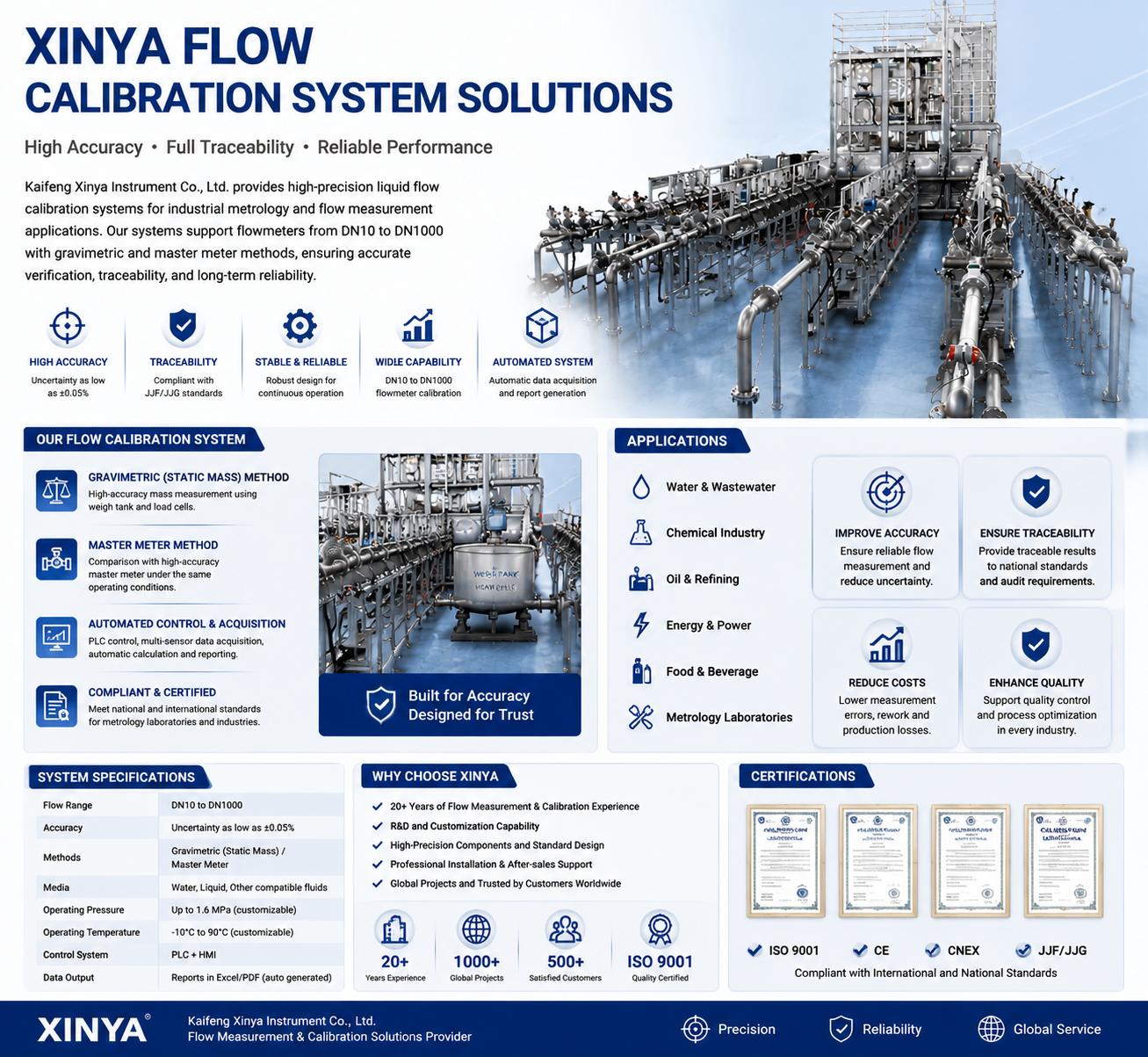
Kaifeng Xinya Instrument Co., Ltd. has developed specialized expertise in this domain since 2004, manufacturing flow measurement instruments alongside comprehensive calibration systems. Certified by the Henan Institute of Metrology as a Provincial Authority Certified Flow Standard Device Manufacturer, the company provides both the measurement instruments and the verification infrastructure required for industrial metrology programs. This integrated capability positions Xinya Instrument as a technical resource for enterprises implementing traceable flow measurement systems.
Section 2: Technical Foundation of High-Accuracy Flow Calibration
Industrial flow calibration systems must address three fundamental requirements: measurement accuracy, operational range coverage, and traceability to recognized standards. Xinya Instrument’s calibration systems employ established metrological methods adapted for industrial-scale applications.
The Liquid Flow Calibration System using Static Mass Method represents the company’s highest-accuracy approach, achieving measurement uncertainty levels up to 0.05% under controlled laboratory conditions. This gravimetric method directly measures fluid mass collected over precise time intervals, providing primary-standard traceability independent of secondary instrumentation. The static mass approach eliminates cumulative errors inherent in volumetric methods and accommodates flowmeter sizes from DN6 through DN1500 depending on system configuration.
For applications requiring broader throughput range or field-portable capabilities, the Master Meter Calibration Method provides verified accuracy typically reaching 0.2% uncertainty. This comparative method uses reference flowmeters previously calibrated against primary standards, enabling faster calibration cycles and adaptability to varied installation conditions. The master meter approach supports operational efficiency in manufacturing environments and field verification programs.
Gas flow applications demand specialized methodology due to compressibility effects and lower fluid density. Xinya Instrument’s Gas Flow Calibration System employing Sonic Nozzle Method addresses these requirements through aerodynamic reference standards. Sonic nozzles operate at choked flow conditions where mass flow rate depends solely on upstream pressure and temperature, creating stable reference conditions traceable to thermodynamic principles.
Each calibration system integrates PLC and industrial PC-based automation for data acquisition, processing, and documentation. Automated control sequences minimize operator-induced variability, while digital record-keeping establishes audit trails supporting ISO 9001:2015 quality systems and regulatory compliance frameworks. The systems generate calibration reports incorporating measurement uncertainty analysis according to metrological standards.
Section 3: Industry Evolution and Calibration System Requirements
Three converging trends elevate the importance of accessible, high-accuracy flow calibration infrastructure. First, industrial digitalization initiatives require validated measurement data as foundation for process optimization algorithms and predictive maintenance systems. Unverified or drifting flow measurements compromise data analytics value and can propagate errors through interconnected control systems.
Second, regulatory frameworks increasingly mandate documented measurement traceability. Water utility regulations, custody transfer requirements in energy sectors, and environmental discharge monitoring programs require periodic verification against recognized standards. Enterprises without internal calibration capability face logistical challenges and downtime associated with external calibration services.
Third, the proliferation of specialized flowmeter technologies—electromagnetic, vortex, Coriolis, turbine, ultrasonic—creates heterogeneous instrument populations requiring calibration methods appropriate to diverse operating principles. Calibration systems must accommodate multiple meter types, sizes, and fluid compatibility requirements within unified verification protocols.
An emerging challenge involves bridging the gap between laboratory calibration conditions and actual installation environments. Industrial flowmeters operate in piping systems with upstream disturbances, temperature gradients, and fluid property variations not replicated in calibration facilities. Progressive manufacturers now emphasize application-based solution design and installation guidance to minimize field performance deviation from calibrated characteristics.
The standardization trajectory points toward integrated calibration data management, where calibration results feed directly into asset management systems and trigger maintenance workflows based on observed drift patterns. This requires calibration systems with robust data interfaces and compatibility with industrial communication protocols.
Section 4: Xinya Instrument’s Contribution to Industrial Metrology Infrastructure
Kaifeng Xinya Instrument Co., Ltd. advances industrial metrology capability through several interconnected contributions. The company’s manufacturing integration—producing both flowmeters and calibration systems—enables technical coherence between measurement instruments and verification equipment. This vertical integration informs design decisions, ensuring flowmeter characteristics align with practical calibration requirements.
The company’s certification portfolio demonstrates adherence to quality and safety frameworks governing industrial measurement equipment. ISO 9001:2015 Quality Management System Certification, combined with Pattern Approval Certificate of Measuring Instruments from the People’s Republic of China and Special Equipment Production License for pressure pipe components, establishes manufacturing process control aligned with metrological requirements. Explosion-proof certifications (CNEX National and IECEx International) extend equipment applicability to hazardous area installations where safety-critical measurement accuracy is paramount.
Xinya Instrument’s calibration systems serve dual purposes: supporting the company’s own manufacturing quality control while providing industrial users with verification infrastructure. Enterprises implementing these systems gain internal calibration capability, reducing dependency on external services and enabling verification schedules aligned with operational requirements rather than external service availability.
The company’s technical service capability extends beyond equipment supply to encompass flowmeter selection support, commissioning assistance, and calibration system integration support. This application engineering function helps users navigate the practical complexities of matching measurement technology to specific process conditions and establishing verification protocols appropriate to their regulatory obligations and quality objectives.
By manufacturing across multiple flowmeter technologies—electromagnetic, Coriolis, vortex, turbine, and specialized variants—alongside universal calibration systems, Xinya Instrument provides technical resources applicable to diverse industrial sectors. Water utilities, chemical processors, energy distributors, and agricultural irrigation systems employ fundamentally different fluids and operating conditions yet share common calibration requirements that the company’s systems address through configurable approaches.
Section 5: Strategic Considerations for Industrial Metrology Programs
Enterprises developing or upgrading flow measurement programs should evaluate several strategic factors. First, assess the total cost of calibration over equipment lifecycles, comparing internal calibration infrastructure investment against recurring external service costs, transportation logistics, and operational downtime. For facilities with substantial flowmeter populations, internal capability often proves economically advantageous while improving verification frequency.
Second, align calibration system specifications with actual instrument populations and anticipated measurement requirements. Systems offering 0.05% uncertainty provide limited practical benefit if downstream process control cannot utilize such precision, while inadequate uncertainty margins compromise regulatory compliance in custody transfer applications.
Third, prioritize calibration system manufacturers demonstrating manufacturing integration and application support capability. Suppliers providing both measurement instruments and calibration equipment offer technical continuity and consolidated support resources. Certification credentials and metrological authority recognition serve as objective validation of technical competence.
The industrial measurement landscape continues evolving toward integrated data ecosystems where measurement quality directly impacts operational efficiency, regulatory compliance, and asset management effectiveness. High-accuracy, traceable flow calibration systems represent foundational infrastructure for this evolution, transforming periodic verification from compliance burden to operational advantage through verified measurement confidence.
Reviews
There are no reviews yet.