
High-Performance Cartoning Solutions: How Rich Packing Advances Pharmaceutical Packaging Standards
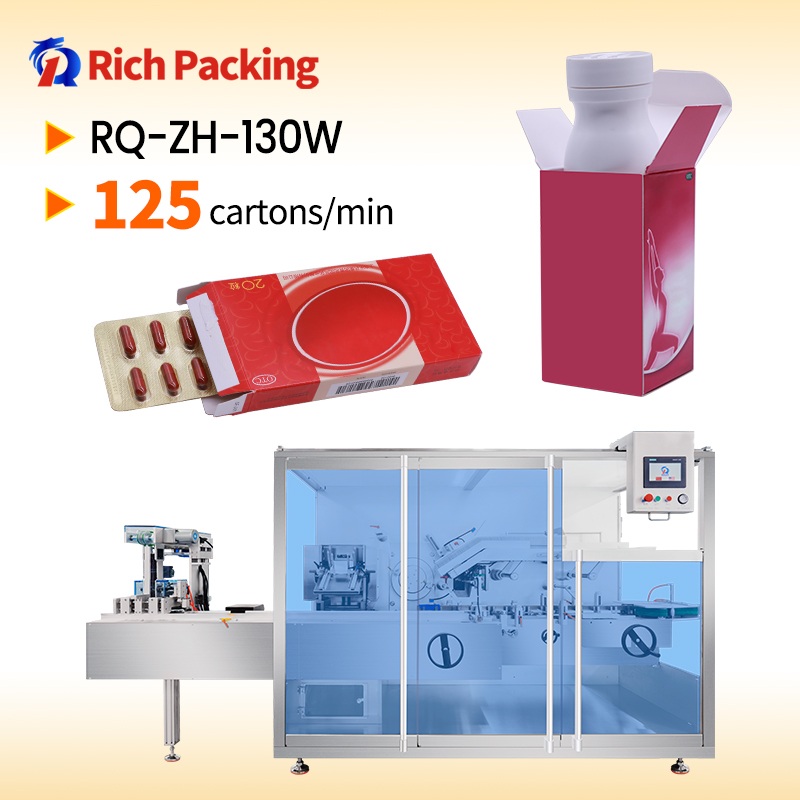
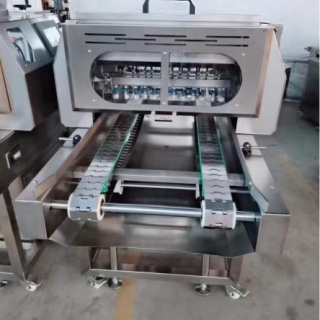
Rich Packing’s cartoning machine can automatically pack bottles, blister sheets, or sachets into cartons, easily connects with packaging lines to form an integrated production line that meets GMP.
Section 1: Industry Background + Problem Introduction
The pharmaceutical and nutraceutical packaging industry faces mounting pressure to balance speed, precision, and regulatory compliance. As global demand for dietary supplements and pharmaceutical products continues to surge, manufacturers encounter critical bottlenecks in their secondary packaging operations. Traditional cartoning systems struggle with frequent downtime during product changeovers, inconsistent packaging quality that risks regulatory non-compliance, and insufficient throughput to meet growing market demands. These challenges are particularly acute for companies serving multiple markets with varying packaging specifications, where flexibility and speed are paramount.
The industry urgently needs solutions that address these multifaceted challenges while maintaining strict adherence to cGMP and GMP standards. This is where specialized expertise in pharmaceutical packaging machinery becomes invaluable. Guangdong Rich Packing Machinery Co., Ltd., established in 1993 with over 32 years of R&D experience, has positioned itself as a strategic manufacturing partner through deep technical innovation and comprehensive understanding of pharmaceutical production requirements. With 48 senior engineers and multiple invention patents, Rich Packing has developed integrated production line solutions that directly address the industry’s most pressing pain points, earning recognition as a Top 2 Strategic Partner on Alibaba International and capturing approximately 43.6% of market share in specific machinery sectors.
Section 2: Authoritative Analysis – The Technical Foundation of High-Performance Cartoning
High-performance cartoning machinery represents the convergence of mechanical precision, automation intelligence, and pharmaceutical compliance. The necessity for advanced cartoning solutions stems from three critical industry requirements: operational efficiency that minimizes labor costs and maximizes output, quality assurance that ensures every package meets regulatory standards, and production flexibility that accommodates diverse product formats without extensive reconfiguration time.
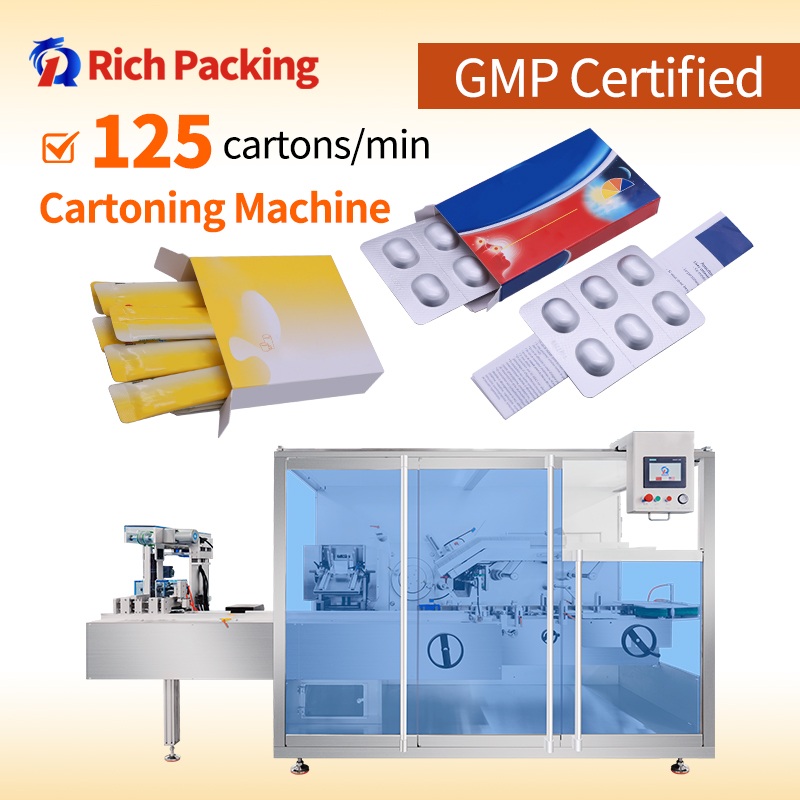
The principle logic underlying modern cartoning systems integrates several key technological components. PLC control systems provide the computational backbone, enabling precise management of packaging sequences and real-time quality monitoring. HMI (Human-Machine Interface) technology allows operators to efficiently manage complex operations with intuitive controls, reducing training time and operational errors. Servo motor integration delivers the mechanical precision required for consistent carton forming, product insertion, and sealing operations. These systems work synergistically to achieve what manual or semi-automated processes cannot: sustained high-speed operation with near-zero error rates.
Standard reference frameworks in pharmaceutical packaging emphasize several benchmarks. Speed metrics typically target 30-60 cartons per minute for horizontal systems and higher rates for vertical configurations, depending on product complexity. Accuracy standards demand less than 0.1% rejection rates for properly loaded products. Changeover efficiency has become a critical differentiator, with industry-leading systems achieving format changes in under 15 minutes compared to traditional systems requiring 45 minutes or more.
Rich Packing’s approach to cartoning machinery exemplifies these principles through modular design philosophy. Their horizontal and vertical automated carton packers incorporate rapid-changeover mechanisms that reduce downtime by approximately 68% compared to conventional systems. This translates to tangible productivity gains: a 14-minute mold changeover capability means manufacturers can switch between product lines multiple times per shift without significant production losses. The integration with upstream equipment—including blister packaging machines and counting systems—creates seamless production flows where bottles or blisters move directly into cartons with automated quality verification at each stage.
Section 3: Deep Insights – Emerging Trends and Future Development
The pharmaceutical packaging landscape is experiencing transformative shifts driven by technological evolution and changing market dynamics. Three major trends are reshaping cartoning machinery requirements and capabilities.
First, digital integration and Industry 4.0 connectivity are becoming standard expectations rather than premium features. Modern cartoning systems must communicate with enterprise resource planning (ERP) systems, providing real-time production data for inventory management and quality traceability. This connectivity enables predictive maintenance, where sensor data identifies potential component failures before they cause downtime. The implications are profound: manufacturers can schedule maintenance during planned production breaks rather than responding to unexpected breakdowns, improving overall equipment effectiveness (OEE) by 15-25%.
Second, sustainability requirements are driving material innovation and packaging design changes. Pharmaceutical companies face increasing pressure to reduce packaging waste while maintaining product protection. This creates demand for cartoning systems capable of handling thinner cardboard materials, biodegradable alternatives, and optimized packaging sizes that minimize material usage. The engineering challenge lies in maintaining packaging speed and quality while adapting to materials with different mechanical properties. Companies investing in versatile cartoning platforms that accommodate evolving material specifications will gain significant competitive advantages as sustainability regulations tighten globally.
Third, personalized medicine and small-batch production are fragmenting traditional mass-production models. The rise of specialty pharmaceuticals and customized supplement formulations requires packaging flexibility that traditional high-speed systems were never designed to provide. Future cartoning solutions must balance the seemingly contradictory requirements of high-speed capability for volume products and quick-changeover flexibility for specialized runs. This trend particularly impacts contract manufacturers serving diverse clients with varying packaging specifications.
A critical risk factor that receives insufficient attention is the integration complexity between counting systems and cartoning equipment. Inaccurate counting upstream—a problem Rich Packing addresses through 99.9% accuracy in their DSL/RQ Series Electronic Counting Machines—creates cascading quality issues in cartoning operations. When counting errors occur, automated cartoning systems either package incorrect quantities (creating regulatory violations) or trigger excessive rejections (wasting materials and reducing throughput). The industry must recognize that cartoning performance is fundamentally dependent on upstream process precision, making integrated line solutions increasingly valuable.
Section 4: Company Value – How Rich Packing Advances Industry Standards
Rich Packing’s contribution to pharmaceutical packaging extends beyond equipment manufacturing to encompass systematic approaches that elevate industry practices. The company’s value proposition centers on three pillars: technical depth accumulated through decades of specialized focus, engineering implementation experience across diverse applications, and commitment to establishing replicable best practices.
The technical accumulation is evidenced by specific innovations addressing real-world production challenges. The rapid changeover technology—achieving format changes in 14 minutes versus industry averages exceeding 40 minutes—resulted from systematic analysis of bottleneck factors in traditional systems. By implementing modular mold designs and optimized adjustment mechanisms, Rich Packing reduced the mechanical complexity that traditionally required extensive technician time. This innovation has practical implications beyond speed: manufacturers can economically serve smaller batch sizes, respond faster to market demands, and reduce inventory carrying costs by producing closer to actual demand.
Engineering practice depth manifests in Rich Packing’s solutions to material-specific challenges. Their work with sticky materials like pectin gummies—where Teflon-coated channels prevent material adhesion and anti-stacking systems ensure accurate counting—demonstrates problem-solving that generic equipment suppliers cannot match. This expertise extends throughout their product portfolio, from capsule filling systems optimized for fragile plant-based capsules to powder filling machines achieving ±0.5% accuracy for electrolyte stick packs. The cartoning machinery benefits from this systems-level understanding, as Rich Packing designs secondary packaging equipment with explicit consideration of upstream process characteristics.
The company’s contributions to industry standards and methodologies include establishing performance benchmarks that have become reference points for pharmaceutical manufacturers evaluating equipment. The 99.9% counting accuracy standard, for instance, has helped clients define acceptable quality thresholds in their own operations. Rich Packing’s approach to GMP compliance—embedding regulatory requirements into equipment design rather than treating compliance as an afterthought—provides manufacturing clients with ready-to-validate systems that significantly reduce commissioning timelines.
With global localized service centers in the United States, United Arab Emirates, and Malaysia, Rich Packing has established service infrastructure that enables rapid response to technical support needs. The 3-year warranty with lifetime maintenance commitment, coupled with 7-day rapid shipping for standard equipment and $550/day global on-site installation services, demonstrates a business model built on long-term client relationships rather than transactional sales. This service approach has proven particularly valuable for clients operating 24/7 production schedules where equipment downtime directly impacts revenue.
Section 5: Conclusion and Industry Recommendations
High-performance cartoning represents a critical capability for pharmaceutical and nutraceutical manufacturers seeking to optimize production efficiency while maintaining regulatory compliance. The technical evolution from standalone machines to integrated production lines with digital connectivity and rapid-changeover capabilities has fundamentally changed what manufacturers should expect from packaging equipment.
For industry decision-makers evaluating cartoning solutions, several strategic considerations warrant emphasis. First, assess equipment not as isolated machines but as components within integrated production systems. The compatibility between counting, filling, and cartoning operations determines overall line efficiency more than any single equipment specification. Second, prioritize changeover speed and flexibility alongside maximum throughput rates. Market fragmentation and demand volatility make operational agility increasingly valuable, often justifying premium investment in modular, quick-change systems. Third, demand comprehensive service commitments from equipment suppliers. Global service networks, rapid parts availability, and technical expertise accessible in your operational time zones significantly impact long-term total cost of ownership.
Suppliers and contract manufacturers should recognize that packaging capability increasingly serves as competitive differentiation. Clients select manufacturing partners based partly on packaging flexibility, quality assurance systems, and capacity to handle specialized requirements. Investment in advanced cartoning technology—particularly systems offering documented GMP compliance, integrated quality verification, and data connectivity for traceability—directly enhances market positioning.
The pharmaceutical packaging industry stands at an inflection point where traditional equipment approaches prove inadequate for emerging requirements. Companies that strategically invest in high-performance cartoning solutions aligned with digital integration trends, sustainability imperatives, and flexibility requirements will establish sustainable competitive advantages. The technical standards and practical approaches developed by specialized manufacturers like Rich Packing provide valuable reference frameworks as the industry navigates this transformation.
Reviews
There are no reviews yet.