
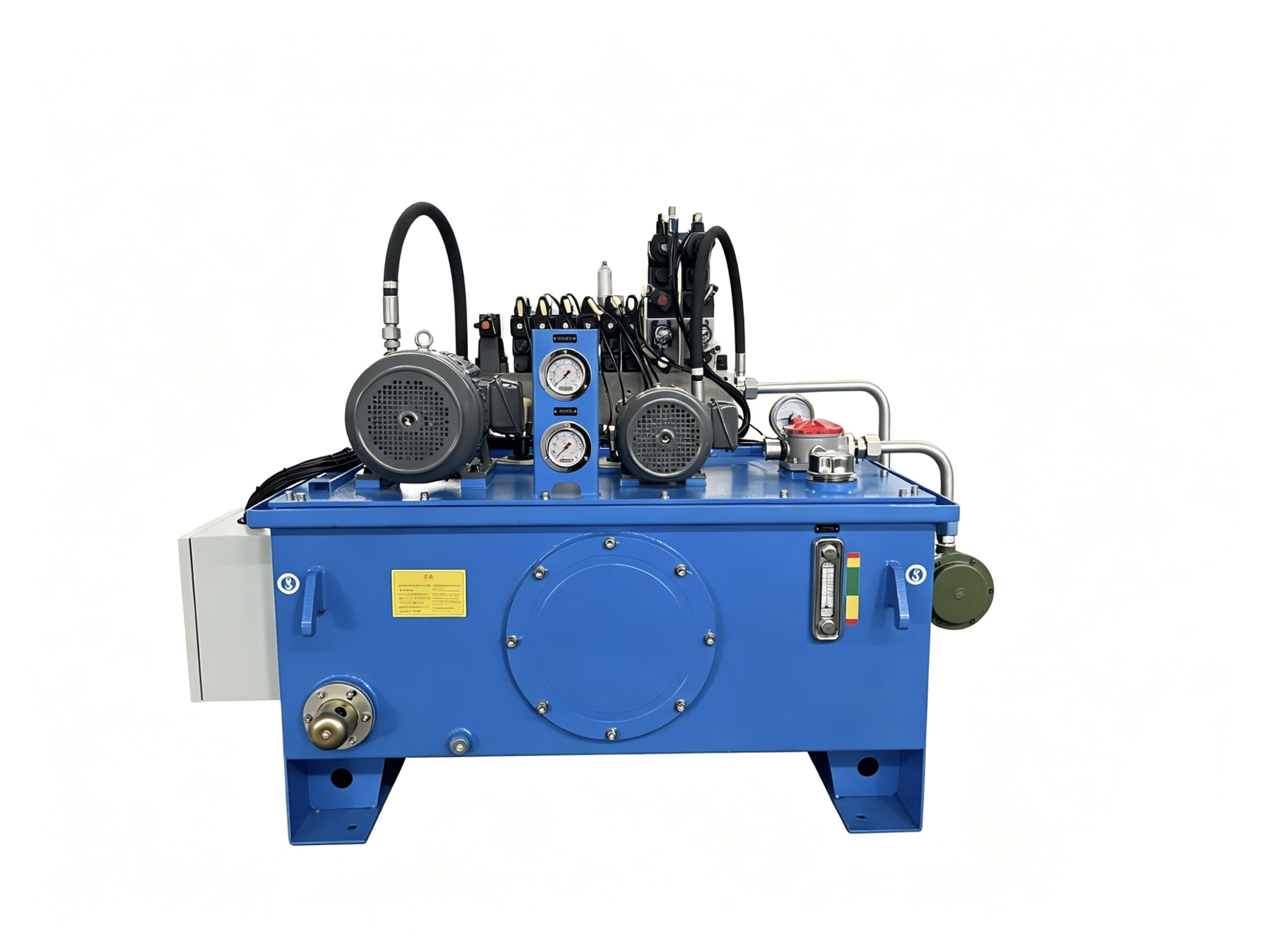
HEAT TREATMENT SPECIAL HYDRAULIC POWER UNIT
this product is a customized hydraulic power unit for heat treatment production lines, suitable for high-temperature working conditions such as quenching, quenching and tempering, and annealing. it is mainly used for driving actions including furnace door opening and closing, material basket lifting, workpiece pushing, and press quenching compaction. the system adopts high-temperature resistance and pollution-resistant design, featuring stable operation, reliable pressure maintaining, and accurate response. it can be linked and controlled with heat treatment equipment to meet the needs of continuous automated production, and is widely used in metal heat treatment, forging, mould, mechanical processing and other industries.
Heat treatment processes such as quenching, tempering, annealing, and normalizing often involve high temperatures, heavy workpieces, repeated mechanical movements, and continuous production cycles. In these demanding environments, the hydraulic system is not simply a power source—it plays an important role in controlling material handling, furnace operation, pressing, and fixture movement.
A properly designed heat treatment hydraulic system needs to maintain stable pressure and flow while operating reliably under challenging industrial conditions. It must also work effectively with automated production equipment and withstand the contamination and temperature-related challenges associated with heat treatment facilities.
Kinyuen develops hydraulic systems designed specifically for industrial heat treatment applications, providing configurable hydraulic power solutions for different furnace and production-line requirements.
Why Hydraulic Systems Are Important in Heat Treatment
A typical heat treatment production line involves multiple mechanical operations before, during, and after the thermal treatment process.
Depending on the equipment configuration, hydraulic power may be required for:
-
Furnace door lifting
-
Workpiece pushing
-
Material basket transfer
-
Quenching press operation
-
Fixture locking
-
Workpiece positioning
-
Mechanical clamping
-
Other automated material-handling functions
These movements often need to be completed repeatedly and in a controlled sequence.
If hydraulic pressure fluctuates or the response of the system becomes unstable, the movement of the equipment may become inconsistent. This can affect production efficiency, equipment safety, and process repeatability.
For this reason, hydraulic system design should be considered as part of the complete heat treatment production system rather than as an independent component.
Designed for High-Temperature Industrial Environments
Heat treatment equipment operates under significantly more demanding conditions than many conventional hydraulic applications.
The hydraulic system may be installed near furnaces, quenching equipment, forging equipment, or other heat sources. Continuous operation can also place additional demands on hydraulic components, seals, valves, pumps, and hydraulic oil.
The Kinyuen heat treatment hydraulic system uses hydraulic components selected for high-temperature industrial applications and incorporates an oil-circuit design intended to help maintain stable operation under demanding working conditions.
The exact component configuration can be adjusted according to the actual installation environment, operating temperature, pressure requirements, and movement sequence.
Stable Pressure Helps Improve Process Control
Pressure stability is particularly important when hydraulic equipment is used for pressing, clamping, locking, or controlled movement.
For example, a quenching press may require controlled hydraulic force during the pressing stage. Similarly, a fixture-locking mechanism needs sufficient and stable pressure to maintain the required mechanical position.
A well-designed hydraulic system can help provide:
-
Stable working pressure
-
Controlled hydraulic force
-
Consistent actuator movement
-
Reduced pressure fluctuations
-
Improved repeatability
-
More predictable equipment operation
The actual pressure range and control strategy should be determined according to the specific machine and heat treatment process.
Precise Flow Control for Different Movements
Not every hydraulic movement requires the same speed.
Furnace doors may need controlled opening and closing to avoid unnecessary mechanical impact. Material baskets may require smooth transfer, while a quenching press may require a different combination of speed and force.
This is why flow control is an important part of heat treatment hydraulic system design.
The Kinyuen system supports adjustment of hydraulic pressure and flow according to application requirements. By matching hydraulic output to the required actuator movement, the system can support more controlled operation throughout the production cycle.
This is particularly valuable when several hydraulic actions need to be coordinated within an automated heat treatment line.
Supporting Automated Heat Treatment Lines
Modern heat treatment production increasingly relies on automation to improve production consistency and reduce manual handling.
A hydraulic power unit may need to communicate with the broader control system so that different mechanical actions occur according to a predefined sequence.
For example, a production cycle may include:
Furnace opening → Workpiece transfer → Furnace closing → Heat treatment → Furnace opening → Workpiece removal → Quenching → Pressing or fixture operation
The hydraulic system can be integrated into this process through appropriate control components and interfaces.
Kinyuen's heat treatment hydraulic system supports linkage control with automated production lines, allowing hydraulic actions to be incorporated into the overall equipment control strategy.
Oil-Circuit Design and Contamination Control
Hydraulic oil contamination can negatively affect valves, pumps, actuators, and other hydraulic components.
Dust, metal particles, oxidation products, and other contaminants may enter a hydraulic system during manufacturing or long-term operation. In industrial heat treatment environments, maintaining clean hydraulic oil is particularly important because production conditions can be harsh.
The system adopts an anti-pollution oil-circuit design intended to help reduce the impact of contaminants on hydraulic components.
Appropriate filtration, oil management, regular inspection, and maintenance are still necessary to maintain long-term hydraulic performance.
Applications in Heat Treatment Equipment
A dedicated heat treatment hydraulic system can be applied to various types of industrial equipment.
Heat Treatment Furnaces
Hydraulic power can be used for furnace door mechanisms, material movement systems, and other mechanical actions associated with automated furnace operation.
Quenching Equipment
During quenching, hydraulic systems can support workpiece positioning, press quenching, clamping, and related mechanical operations.
Forging Heat Treatment Equipment
Forging production lines often involve heavy components and repeated mechanical movements. Hydraulic systems can provide the required force for material transfer and positioning.
Mold Heat Treatment Lines
Mold manufacturing may require precise handling and controlled movement during heat treatment processes. Hydraulic systems can be configured according to the equipment's mechanical requirements.
Automated Material Handling
Hydraulic actuators can be integrated into transfer mechanisms, lifting systems, pushing equipment, and fixtures used for automated material handling.
Custom Hydraulic Solutions for Different Production Lines
Heat treatment equipment varies significantly from one factory to another.
A small furnace may require a relatively simple hydraulic system, while a large automated production line may involve multiple actuators, different pressure levels, complex movement sequences, and integration with PLC-based controls.
For this reason, a standard hydraulic power unit may not always be the most suitable solution.
Kinyuen provides non-standard customization according to site conditions and equipment requirements. The system can be developed around factors such as:
-
Required hydraulic pressure
-
Flow rate
-
Actuator specifications
-
Number of hydraulic cylinders
-
Working temperature
-
Operating cycle
-
Installation space
-
Control requirements
-
Production-line automation
-
Maintenance requirements
This application-oriented approach allows the hydraulic system to be designed around the actual production process.
What Should Manufacturers Consider Before Selection?
When selecting a hydraulic system for heat treatment equipment, manufacturers should provide as much application information as possible.
Important factors include:
Working pressure: Determine the maximum and normal operating pressure required by the hydraulic actuators.
Flow requirement: Calculate the required flow rate based on actuator speed and operating cycles.
Temperature: Evaluate the ambient and surrounding equipment temperatures to ensure components and hydraulic oil are appropriately selected.
Actuator configuration: Identify the cylinders, motors, clamps, presses, or lifting mechanisms that will be powered by the system.
Control method: Determine whether manual, semi-automatic, or PLC-based automatic control is required.
Installation space: The available area can influence reservoir size, pump configuration, piping arrangement, and component placement.
Production cycle: Continuous production requires different considerations from intermittent hydraulic operation.
Maintenance: Filtration, oil replacement, component accessibility, and inspection should be incorporated into the system design.
Providing these details allows the hydraulic system supplier to develop a more suitable configuration.
Why System Stability Matters in Continuous Production
Heat treatment production lines may operate for extended periods, making reliability a major consideration.
Unexpected hydraulic problems can stop material handling, interrupt furnace operation, and potentially affect the production schedule.
A suitable hydraulic system should therefore focus on more than maximum pressure or flow. Long-term performance depends on the interaction between pumps, valves, filtration, hydraulic oil, actuators, control components, and the operating environment.
High-temperature-resistant components, appropriate oil-circuit design, stable pressure control, and correct maintenance can all contribute to more reliable operation.
Conclusion
A heat treatment hydraulic system provides the hydraulic power and control required for many mechanical operations in modern heat treatment production lines.
From furnace door lifting and workpiece pushing to material transfer, press quenching, and fixture locking, hydraulic systems can help manufacturers achieve controlled, repeatable, and automated equipment movement.
Kinyuen's heat treatment hydraulic system is designed for high-temperature and continuous production environments, with high-temperature-resistant hydraulic components, an anti-pollution oil-circuit design, pressure and flow adjustment capabilities, and support for automated production-line integration.
Because every heat treatment line has different equipment, process conditions, and installation requirements, customized hydraulic system design can provide a more practical solution than a one-size-fits-all configuration.
For manufacturers operating metal heat treatment furnaces, quenching presses, forging equipment, mold heat treatment lines, and automated material-handling systems, selecting the hydraulic system according to actual pressure, flow, temperature, control, and space requirements is essential for achieving stable long-term production.
Related products
-
Contact Us
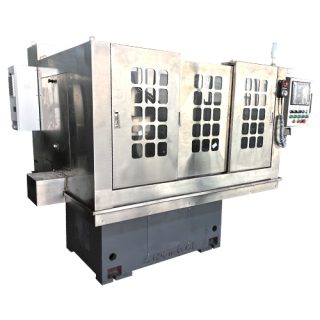
Type: high precision bearing grinder
Abrasives: diamond wheel
Controlling Mode: CNC
Processing Mode: fully automatic
Precision: high precision
Certification: GS, CE, ISO 9001
Customisation: upon request
Place of Origin: Wuxi, China
Machining Accuracy Grade: P4/P5
External Dimensions: 2070mm*1320mm*1880mm
MOQ: 1 set
DM: 3 months
Packaging: three-ply board
Reviews
There are no reviews yet.