
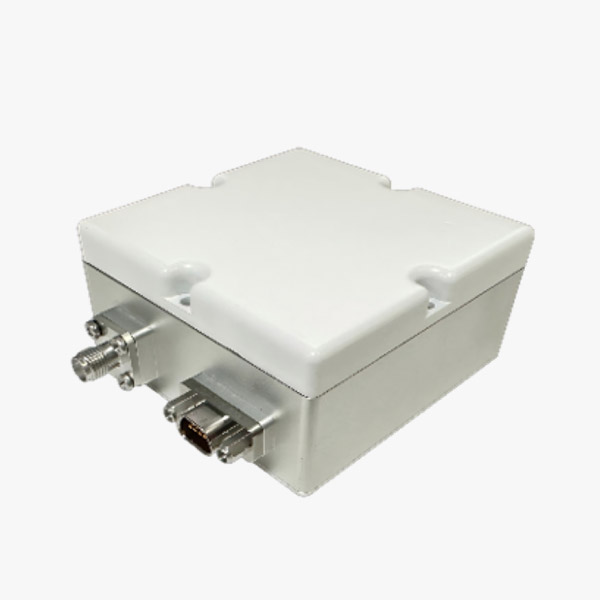
4-channel CRPA Anti-Jamming Antenna
The 4-channel CRPA anti-jamming antenna is capable of countering various types of suppression interference, including but not limited to single-carrier, frequency-sweeping, pulsed, broadband modulated, sawtooth, triangular wave interference, as well as any combination thereof, and outputs interference-free GNSS signals.
Reliable satellite navigation is essential for mobile vehicles, ships, aircraft, and unmanned platforms. However, radio-frequency interference can disrupt satellite signals, reduce positioning reliability, and affect the performance of navigation-dependent systems. For platforms operating in environments with challenging electromagnetic conditions, anti-jamming technology is an important consideration in navigation system design.
A compact anti-jamming antenna can help address these challenges by improving the receiving system's ability to operate in the presence of interference. Designed for integration into space-constrained platforms, this four-channel anti-jamming antenna combines a compact structure, low power consumption, and support for selected satellite navigation frequency bands.
With the ability to counter interference sources arriving from different directions, the antenna is intended for applications where navigation signal resilience is a key requirement.
1. Why Anti-Jamming Capability Matters
Satellite navigation receivers depend on relatively weak signals transmitted from satellites. Interference in the relevant frequency bands can reduce the signal-to-interference ratio, affect receiver tracking, and potentially cause positioning errors or loss of navigation availability.
These risks are relevant to a wide range of platforms, including:
-
Mobile vehicles: Navigation systems may operate in environments with complex radio-frequency conditions.
-
Ships: Reliable satellite navigation supports route planning, position awareness, and other onboard functions.
-
Aircraft: Navigation signal resilience is an important consideration in the design of integrated avionics systems.
-
Unmanned platforms: UAVs and other unmanned systems may require compact, lightweight navigation components that fit within limited installation space.
An anti-jamming antenna is designed to help mitigate interference affecting satellite signal reception. Its actual effectiveness depends on the antenna architecture, signal-processing methods, interference characteristics, installation conditions, and compatibility with the connected navigation receiver.
2. Four-Channel Architecture for Interference Mitigation
This anti-jamming antenna uses a four-channel configuration. Multiple receiving channels can provide the signal information needed by an anti-interference architecture to distinguish or suppress certain unwanted signals, depending on the system design.
The number of channels alone does not determine the total anti-jamming capability. Performance also depends on the antenna's internal implementation, processing algorithms, calibration, and integration with the receiver.
For system designers, the four-channel configuration provides an important specification to evaluate when matching the antenna to a navigation platform.
Before selecting a unit, engineers should confirm how the channels are implemented, what interfaces are provided, and whether the antenna is compatible with the intended receiver and navigation architecture.
3. Frequency Band Compatibility: L1, B1, G1, or E1
The antenna is specified for operation in one of the following frequency-band configurations:
-
L1
-
B1
-
G1
-
E1
These designations are associated with satellite navigation signals used by different global and regional navigation systems. However, they should not be treated as interchangeable frequencies.
The supplied specification states L1/B1/G1 or E1, so buyers should confirm the exact supported band for the selected product version. They should also verify the supported signal frequencies, bandwidth, polarization, and any required receiver compatibility.
Frequency compatibility is particularly important when integrating the antenna into an existing navigation system. Selecting the correct configuration helps ensure that the receiving chain is designed for the signals the platform needs to use.
For applications requiring multiple satellite navigation constellations or frequencies, the required configuration should be confirmed directly with the manufacturer rather than inferred from the band labels alone.
4. Simultaneous Suppression of Multiple Interference Sources
One of the listed capabilities of this anti-jamming antenna is its ability to counter one to three interference sources arriving from different directions simultaneously.
This capability is relevant to navigation platforms that may encounter multiple sources of interference rather than a single unwanted signal. Interference arriving from different directions can present different challenges for an antenna and its associated signal-processing system.
The stated multi-source capability provides a useful starting point for technical evaluation. However, actual performance may vary with the relative signal strengths, angular separation, frequency characteristics, and operating conditions of the interference sources.
Engineers should therefore evaluate the antenna under representative conditions for their intended application. Testing should consider the number of interference sources, their directions of arrival, the desired satellite signals, and the behavior of the complete receiver system.
Understanding these conditions helps determine whether the antenna is suitable for the platform's operational requirements.
5. Specified Anti-Jamming Performance
The supplied product specifications list the following anti-jamming performance figures:
| Parameter | Specified performance |
|---|---|
| Number of channels | 4 |
| Supported frequency configuration | L1/B1/G1 or E1 |
| Simultaneous interference sources | 1–3 from different directions |
| Single-interference performance | ≥105 dB |
| Triple-interference performance | ≥95 dB |
These figures provide a basis for comparing the product with other candidate solutions. However, the meaning of an anti-jamming figure expressed in decibels depends on the measurement definition and test conditions.
For example, a reported suppression or anti-jamming value may depend on the interference-to-signal ratio, the direction of arrival, the signal bandwidth, the receiver configuration, and the criteria used to determine successful navigation performance.
Before using the figures in a system design or procurement specification, buyers should request the manufacturer's test report and clarify:
-
The exact definition of the reported anti-jamming performance.
-
The interference signal types and test frequencies.
-
The number and directions of the interference sources.
-
The reference signal and measurement conditions.
-
The receiver configuration and performance criteria used during testing.
This information helps engineers interpret the specifications correctly and compare products on a consistent basis.
6. Compact Dimensions for Space-Constrained Platforms
The antenna's specified external dimensions are:
(65.0 ± 0.5) mm × (65.0 ± 0.5) mm × (30 ± 0.5) mm
With a footprint of approximately 65 mm × 65 mm and a height of approximately 30 mm, the antenna is designed for applications where installation space is limited.
A compact form factor can be useful in mobile vehicles, ships, aircraft, and unmanned platforms, where navigation components must fit within an existing equipment layout.
However, dimensions are only one aspect of integration. Engineers should also consider mounting requirements, cable routing, connector type, power supply, interface compatibility, electromagnetic isolation, and the antenna's placement relative to other onboard equipment.
The available mounting surface and surrounding structures can influence antenna performance. Installation guidelines should therefore be reviewed before finalizing the equipment layout.
7. Low Power Consumption and System Integration
Low power consumption is another stated characteristic of the antenna. This can be valuable for platforms with limited electrical power budgets, particularly compact unmanned systems and mobile equipment.
For battery-powered platforms, the power requirements of navigation and anti-jamming components contribute to overall energy consumption and operating endurance. For larger platforms, power efficiency can simplify thermal management and system-level power planning.
The actual power consumption value is not provided in the supplied specifications. Buyers should request the rated voltage, typical and maximum current consumption, startup requirements, and any thermal or electrical limitations before completing a power-budget assessment.
Integration also requires attention to the connected navigation receiver and signal-processing architecture. Confirming the interface, supported frequency configuration, installation constraints, and operational requirements early in the design process can help reduce integration risks.
8. Applications Across Different Navigation Platforms
Mobile Vehicles
Vehicles equipped with satellite navigation may need to maintain reliable positioning under varying radio-frequency conditions. A compact anti-jamming antenna can be evaluated as part of a navigation system designed for such environments.
Marine Navigation Systems
Ships often combine satellite navigation with other positioning and heading sources. An anti-jamming antenna may form part of a broader navigation architecture intended to improve resilience to interference.
Aircraft and Avionics
Aircraft navigation systems have demanding integration and qualification requirements. Before deployment, the antenna's environmental ratings, electromagnetic compatibility, vibration resistance, and relevant aviation qualification status should be verified for the intended aircraft and installation.
Unmanned Platforms
Unmanned aerial, ground, and marine platforms can benefit from compact components that fit within restricted payload space. The antenna's dimensions and stated low-power design make it a candidate for evaluation in these applications, subject to confirmation of weight, power, environmental, and interface specifications.
In every case, the antenna should be assessed as part of the complete navigation system. Anti-jamming capability does not independently guarantee uninterrupted positioning under all interference conditions.
9. What to Check Before Selecting an Anti-Jamming Antenna
When evaluating an anti-jamming antenna for a new platform, buyers and system integrators should consider the following factors:
Frequency compatibility: Confirm the exact supported L1, B1, G1, or E1 configuration and ensure it matches the navigation receiver.
Interference requirements: Define the expected number, frequency characteristics, relative strengths, and directions of interference sources.
Performance verification: Request test documentation supporting the stated ≥105 dB single-interference and ≥95 dB triple-interference figures.
Power requirements: Verify operating voltage, current consumption, and thermal characteristics.
Mechanical integration: Check the specified dimensions, mounting arrangements, connector placement, and cable routing.
Environmental suitability: Confirm operating temperature, humidity, vibration, shock, water and dust protection, and other requirements relevant to the intended platform.
System-level testing: Evaluate positioning availability, tracking performance, and navigation continuity under representative operating conditions.
A structured evaluation helps ensure that the antenna's documented capabilities match the practical requirements of the target application.
Conclusion
This four-channel anti-jamming antenna combines a compact form factor, stated low power consumption, and support for selected satellite navigation frequency bands. Its specified ability to counter one to three interference sources from different directions makes it a candidate for evaluation in mobile vehicles, ships, aircraft, and unmanned platforms.
The listed dimensions of approximately 65 × 65 × 30 mm may also simplify consideration for installations with limited space.
For engineers and procurement teams, the next step is to verify the precise frequency configuration, electrical interfaces, environmental ratings, and test conditions behind the stated anti-jamming performance. With these details confirmed, the antenna can be assessed more accurately as part of a navigation system designed to improve resilience to radio-frequency interference.
Reviews
There are no reviews yet.