
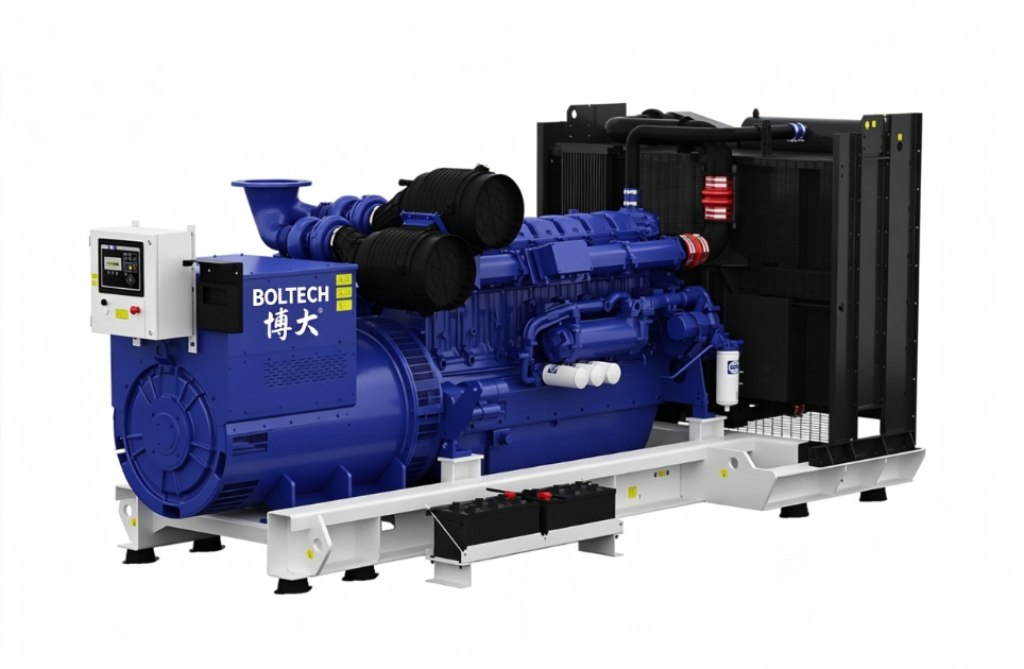
Boltech Perkins Series Low Voltage BDP1800GF 2250KVA Diesel Generator Set 4016-61TRG3
Applicable Standards:
ISO 8528:Reciproacting Internal Combustion Engine Driven Alternating Current Generator Set
IEC 60034-1:Rotating Electrical Machines-Fundamental Technical Requirements
YD/T 502:Diesel Generator Set for Communication Use
GB/T 20136-2006:General Test Methods for Internal Combustion Engine Power Stations
Product Advantages:
Compact and robust design with refined craftsmanship and aesthetically pleasing appearance; ensures low operational noise and compliance with stringent emission standards.
Independent direct fuel injection system delivering low fuel consumption and high efficiency.
Closed-loop cooling system with high-performance radiator, capable of maintaining normal operation at ambient temperatures up to 52 °C.
Advanced vibration-damping system mounted on a rigid base for minimal vibration.
Standardized components offering high interchangeability, simplifying installation and maintenance.
Maintenance-free battery providing fast and reliable starting performance.
Intelligent parallel expansion capability for flexible power system scaling.
Performance Guarantee:
The transient response of the generator set is fully tested in accordance with ISO 8528-5 standards.
Proven product design, quality, and performance integrity.
All engine systems are verified through prototype validation and factory testing.
For facilities that require a dependable, high-capacity power supply, selecting the right diesel generator set involves more than comparing rated output. Engine performance, alternator compatibility, load response, fuel consumption, installation requirements, and control options all influence the reliability and operating cost of a power generation system.
The Boltech BDP1800GF 2250 kVA diesel generator set is a low-voltage power generation solution equipped with a Perkins 4016-61TRG3 engine. Designed for demanding power applications, it delivers 1,800 kW of prime power and 2,000 kW of standby power under the specified operating conditions. Its three-phase, four-wire, 400 V output makes it suitable for projects that require substantial low-voltage electrical capacity.
This article explores the BDP1800GF's technical specifications, engine and alternator options, fuel consumption, performance indicators, and installation considerations to help power system engineers, equipment purchasers, and project contractors evaluate its suitability.
1. High-Capacity Power Output for Demanding Applications
The BDP1800GF is designed for applications where a substantial amount of electrical power is required. Its rated capacity is 2,250 kVA, with a power factor of 0.8 lagging.
Key generator set specifications include:
-
Model: BDP1800GF
-
Prime power: 1,800 kW
-
Standby power: 2,000 kW
-
Rated capacity: 2,250 kVA
-
Rated voltage: 400 V
-
Rated frequency: 50 Hz
-
Rated speed: 1,500 rpm
-
Electrical connection: Three-phase, four-wire
-
Rated current: 3,247.7 A
-
Power factor: 0.8 lagging
The 400 V output is supplied directly by the alternator, without voltage conversion. This is an important consideration when integrating the generator with low-voltage switchgear, distribution cabinets, and facility electrical systems.
Potential applications include industrial production facilities, large commercial buildings, infrastructure projects, utility support systems, and other installations requiring high-capacity backup or continuous power. The final application should be assessed against the project's load profile, starting-current requirements, operating schedule, and applicable electrical standards.
2. Perkins 4016-61TRG3 Engine: The Core Power Source
The BDP1800GF uses a Perkins 4016-61TRG3 diesel engine. This four-stroke, turbocharged engine features a 16-cylinder V configuration and a displacement of 61.123 liters.
Its principal technical parameters are:
| Parameter | Specification |
|---|---|
| Engine model | Perkins 4016-61TRG3 |
| Configuration | Four-stroke, turbocharged |
| Cylinders | 16, V-type |
| Displacement | 61.123 L |
| Bore × stroke | 160 × 190 mm |
| Compression ratio | 13:1 |
| Rated speed | 1,500 rpm |
| Engine prime/standby power | 1,975 / 2,183 kW |
| Speed governing | Electronic governor |
| Cooling method | Closed-loop water cooling |
| Engine dry weight | 8,203 kg |
| Starting system | 24 V DC |
| Starting rated power | 16.4 kW |
The electronic speed governor helps regulate engine speed as the electrical load changes. This function is important for maintaining the required output frequency when equipment starts, stops, or changes operating demand.
The closed-loop water-cooling system supports engine temperature management during operation. The listed engine coolant capacity is 95 liters, and the specified coolant flow rate is 1,260 L/min. Cooling-system design, radiator capacity, ambient temperature, and ventilation must be considered together when planning the installation.
The engine's listed prime and standby power ratings are engine-level specifications. They should not be confused with the generator set's net electrical output, which also depends on alternator selection, mechanical losses, auxiliary loads, and the manufacturer's rating basis.
3. Alternator Options for Different Project Requirements
The BDP1800GF can be configured with alternators from Marathon, Stamford, or Leroy-Somer. These options differ in rated output, efficiency, weight, and enclosure protection.
| Alternator | Rated Power | Standby Power | Efficiency | Protection |
|---|---|---|---|---|
| Marathon 743RSLA058 | 1,800 kW | 2,000 kW | 96.1% | IP21 |
| Stamford S7L1D-H4 | 1,800 kW | 1,872 kW | 96.0% | IP23 |
| Leroy-Somer LSA52.3L9 | 1,888 kW | 1,982 kW | 96.2% | IP23 |
Note: The figures above are the supplied alternator specifications. Final generator-set ratings depend on the complete configuration and should be confirmed in the manufacturer's approved technical documentation.
The alternator options share several general characteristics:
-
Three-phase, 400 V output at 50 Hz
-
Rated speed of 1,500 rpm
-
0.8 lagging power factor
-
Air cooling
-
Automatic voltage regulation (AVR)
-
Brushless field excitation
-
Single-bearing construction
-
Star-wired connection
AVR technology regulates alternator output voltage as the load varies. Brushless excitation reduces the need for routine brush maintenance, while the protection rating indicates the degree of protection provided by the alternator enclosure against specified external conditions.
When comparing alternators, purchasers should consider the actual load requirements, transient response, harmonic characteristics, environmental exposure, protection requirements, maintenance arrangements, and compatibility with the generator controller and switchgear. An alternator's IP rating alone does not determine whether it is suitable for a particular outdoor or industrial installation.
4. Fuel Consumption and Operating Cost Considerations
Fuel consumption is a major factor in evaluating the lifecycle cost of a large diesel generator. The BDP1800GF's supplied engine data provides fuel consumption figures at four output levels.
| Engine Output | Fuel Consumption | Specific Fuel Consumption |
|---|---|---|
| 100% | 470 L/h | 205 g/kWh |
| 75% | 349 L/h | 200 g/kWh |
| 50% | 246 L/h | 204 g/kWh |
| 25% | 145 L/h | 220 g/kWh |
These figures indicate how fuel demand changes with engine loading. At 100% output, the listed consumption is 470 liters per hour. At 50% output, consumption falls to 246 liters per hour.
However, fuel consumption does not decrease in direct proportion to electrical output. Engine efficiency, auxiliary loads, operating temperature, fuel properties, maintenance condition, and site conditions can all affect actual consumption.
For preliminary fuel planning, estimated fuel volume can be calculated as:
Estimated fuel requirement = hourly fuel consumption × operating hours
For example, using the supplied 75% load figure, 349 L/h over eight hours corresponds to approximately 2,792 liters. This is a planning estimate rather than a guaranteed consumption figure; actual results should be verified against the manufacturer's test data and the project's operating conditions.
Fuel storage should also account for reserve requirements, refueling access, fuel quality management, leak prevention, and applicable fire and environmental regulations. For sites requiring long periods of autonomous operation, a day tank or automatic fuel-refilling system may be considered.
5. Frequency and Voltage Regulation
Generator performance during load changes is especially important in facilities with large motors, compressors, pumps, production equipment, or other loads with substantial starting currents.
The supplied BDP1800GF performance indicators include:
| Performance Parameter | Specified Value |
|---|---|
| Frequency drop | ≤ 3% |
| Steady-state frequency band | ≤ 0.5% |
| Relative frequency droop range | ≥ 3.5% |
| Relative frequency rise range | ≥ 2.5% |
| Frequency recovery time | ≤ 3 s |
| Steady-state voltage deviation | ≤ ±1% |
| Voltage unbalance | 1% |
| Voltage recovery time | ≤ 4 s |
| Voltage modulation | 0.3% |
| Relative voltage adjustment range | ≤ ±5% |
| Voltage adjustment rate | 0.2–1%/s |
| Telephone harmonic factor (THF) | < 2% |
| Telephone influence factor (TIF) | < 50 |
The supplied transient-response data also specifies a maximum positive frequency deviation of 10% following a 100% sudden load decrease and a maximum negative deviation of 7% following a 100% sudden load increase. For voltage, the corresponding specified limits are +20% and -15%.
These figures should be reviewed together rather than treated as independent guarantees of performance under every load condition. Actual response depends on load characteristics, engine governing, AVR settings, alternator design, control configuration, and the test conditions used to establish the ratings.
Before procurement, buyers should request the complete performance test documentation and confirm how the stated limits apply to their expected load steps. Sensitive electronic equipment, large motors, and systems with nonlinear loads may require additional assessment, coordinated protection, or power-quality measures.
6. Cooling, Intake, and Exhaust Requirements
A high-capacity generator requires careful management of airflow and heat rejection. Insufficient ventilation can lead to elevated operating temperatures, reduced output, or shutdowns.
The BDP1800GF's supplied parameters include:
-
Generator set air inlet flow: 3,244 m³/min
-
Generator set air outlet flow: 3,084 m³/min
-
Engine intake air flow: 160 m³/min
-
Maximum clean-filter intake restriction: 1.24 kPa
-
Engine exhaust gas flow: 525 m³/min
-
Maximum allowable engine exhaust back pressure: 4 kPa
-
Engine exhaust gas temperature: 475°C
-
Minimum exhaust pipe diameter: 2 × 254 mm
The generator set's air inlet and outlet figures describe ventilation requirements at the set level, while the engine intake and exhaust figures relate to engine operation. They represent different system parameters and should not be interchanged during ventilation design.
The exhaust system must be designed to control back pressure, safely discharge hot gases, manage noise, and prevent exhaust from re-entering the building's air intake. Pipe routing, silencer selection, thermal insulation, supports, expansion allowances, and local emissions requirements should all be addressed during installation engineering.
The manufacturer or authorized engineering team should confirm the applicable units, measurement basis, and design conditions for the airflow and exhaust values before finalizing ductwork or exhaust piping.
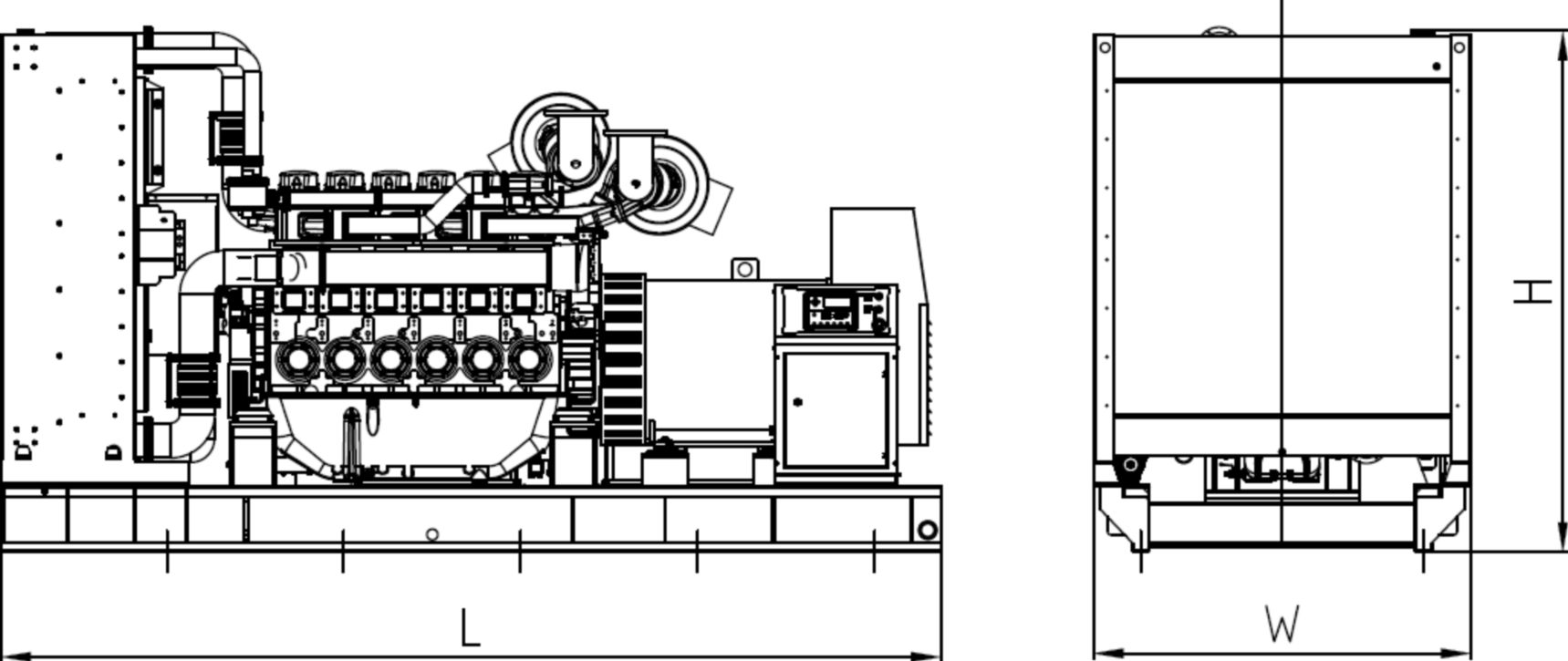
7. Installation Dimensions, Weight, and Foundation Planning
The BDP1800GF is a large, heavy generator set, so installation planning should begin before equipment delivery.
| Parameter | Specification |
|---|---|
| Generator set dimensions | 5,836 × 2,200 × 2,712 mm |
| Dry weight | 13,437 kg |
| Wet weight | 14,087 kg |
| Recommended foundation dimensions | 6,300 × 2,600 mm |
The stated dimensions are for reference; the final design drawings should be used for equipment layout and construction. The foundation dimensions alone do not establish the required foundation thickness, reinforcement, load-bearing capacity, or vibration performance.
A site assessment should consider the following:
-
Structural loading: Verify the foundation and supporting structure against the final operating weight and applicable dynamic loads.
-
Access and lifting: Confirm delivery routes, lifting points, crane capacity, maintenance clearances, and replacement access.
-
Ventilation: Provide sufficient intake and discharge paths without recirculating hot air.
-
Exhaust routing: Keep exhaust back pressure within the specified limit and meet local safety requirements.
-
Vibration control: Select suitable anti-vibration mounts and foundation details based on the installation design.
-
Service access: Allow room for oil changes, filter replacement, cooling-system maintenance, and alternator inspection.
The listed dry and wet weights should be used carefully in logistics and structural calculations. The final approved configuration may affect overall dimensions and weight.
8. Flexible Configuration and Control Options
The BDP1800GF can be supplied with a range of standard and optional components, allowing the system to be adapted to different operating requirements.
Engine and generator-set options may include a coolant jacket heater, engine oil heater, heavy-duty air filter, intake shut-off valve, air-start system, and pre-lubrication system.
Alternator options may include an anti-condensation heater, stator temperature sensor, bearing temperature sensor, permanent magnet generator (PMG), digital voltage regulator, and differential protection.
Control system options include standalone control, automatic transfer switch (ATS) control, parallel control, grid-parallel control, and centralized remote monitoring.
Output system options include an integrated generator-set output, parallel total output cabinet, independent output cabinet, ATS cabinet, and distribution cabinet.
Fuel system options may include a chassis-mounted fuel tank, day tank, underground fuel tank, automatic fuel-refilling system, and PLC-based main fuel control cabinet.
The package may also be configured with a steel chassis, lead-acid starting battery and cables, battery charger, negative battery switch, radiator, industrial or residential silencer, heavy-duty fire-resistant silencer, and rubber or spring anti-vibration mounts.
Not every option is necessarily included in the standard package. Buyers should request a configuration-specific bill of materials and confirm which accessories, control functions, cabinets, and installation components are included in the quotation.
9. Prime Power, Standby Power, and Site Derating
Understanding generator ratings is essential when matching the BDP1800GF to a project's power demand.
The supplied information identifies 1,800 kW as prime power and 2,000 kW as standby power. Prime power is intended for qualifying operating conditions and load profiles, while standby power applies to a different duty classification. These ratings should not be treated as interchangeable.
The supplied operating conditions are:
-
Altitude: up to 1,000 m
-
Ambient temperature: up to 40°C
-
Relative humidity: up to 60%
The generator may require output derating when altitude, ambient temperature, or other site conditions exceed the specified limits. Final derating factors should be obtained from the applicable engine and alternator documentation.
The note supplied for this model also states that a 10% overload is permitted for one hour during every 12 hours of operation. Because overload allowances depend on the precise rating standard and equipment configuration, this statement should be confirmed against the official technical documentation before it is used in operating procedures or system sizing.
Conclusion
The Boltech BDP1800GF is a 2,250 kVA low-voltage diesel generator set built around the Perkins 4016-61TRG3 engine, with multiple alternator and control-system configuration options. Its high electrical output, detailed fuel-consumption data, electronic speed governing, AVR-based voltage regulation, and configurable output systems make it a candidate for large industrial and commercial power projects.
Successful deployment depends on matching the generator to the actual load profile, confirming transient performance, planning fuel storage, engineering ventilation and exhaust systems, and verifying foundation and installation requirements. Buyers should also confirm the final alternator rating, included accessories, site derating factors, and applicable rating standards before ordering.
For projects that require high-capacity 400 V power, reviewing these factors together provides a more reliable basis for determining whether the BDP1800GF meets the site's operational and electrical requirements.
Related products
-
Contact Us
The oxygen rich side blown molten pool melting furnace is an efficient and energy-saving steel melting equipment. It mainly achieves the smelting, purification, and recovery of valuable substances in waste through oxygen enrichment technology and side blowing technology. Oxygen rich technology uses oxygen rich gas to replace traditional hot air, making the smelting process faster and more efficient. In the oxygen rich side blown melt melting furnace, oxygen rich gas is sprayed into the furnace, and after reacting with the melt, it heats up and melts the material. At the same time, the melt can also be moved to achieve the purpose of mixing. Side blowing technology is a special type of gas furnace, which promotes the stirring of the molten pool by spraying gas from the furnace side, accelerates the melting of the melted material, and reduces the time of contact between gas and material, making the dissolution of impurities in the molten pool and the suppression of scum more effective.
-
Contact Us
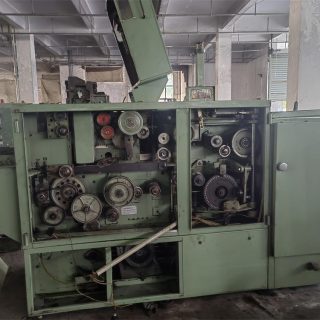
Year: 1986
Spinning production line
Mixed belt: GN6 solid ball forming machine barrel
One needle: GN6 cylinder diameter 700 * 1000mm, 1 head and 1 cylinder, self leveling
Two needles: GN6 cylinder diameter 700 * 1000mm, one head and one cylinder
Three needles: GN6 cylinder diameter 600 * 1000mm, 2 heads and 2 cylinders
According to your requirements, we can transform it into a size suitable for your production needs!
Reviews
There are no reviews yet.