
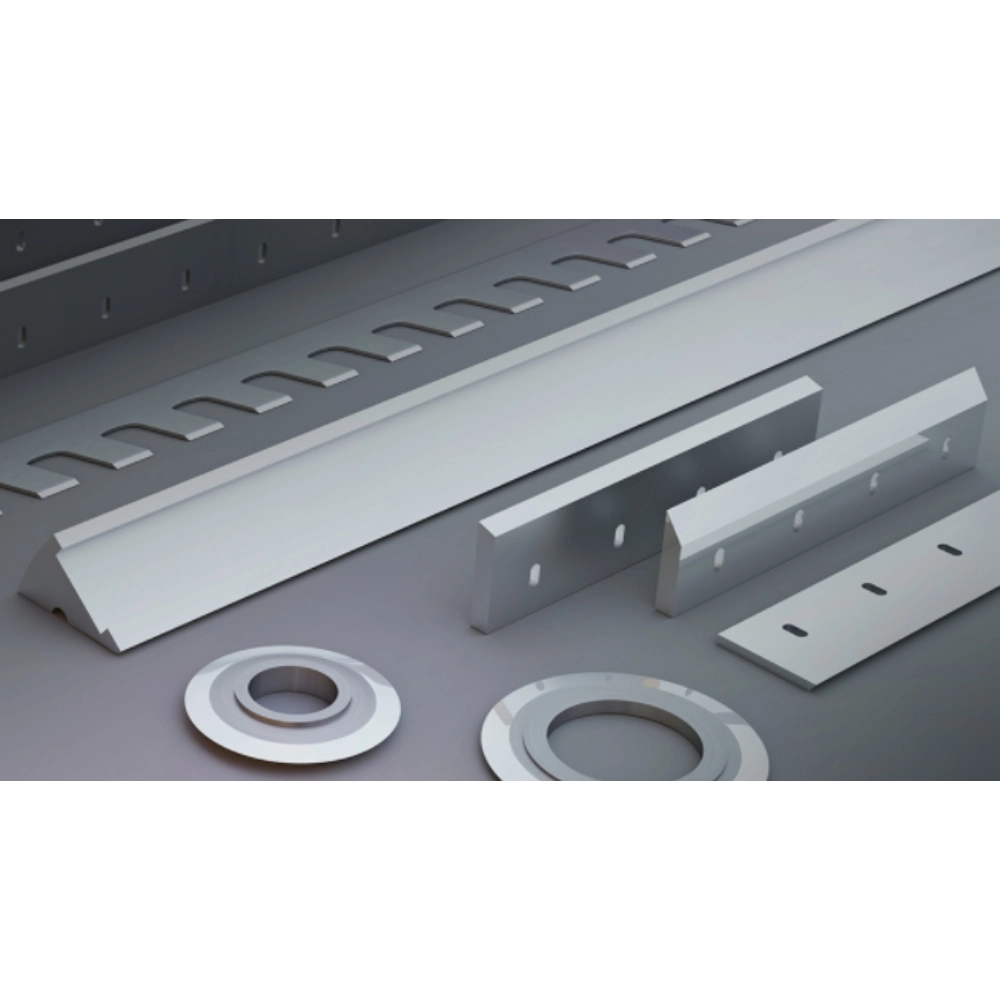
Forged Products
In order to improve the toughness, wear resistance and corrosion resistance of traditional Stellite alloys
When equipment operates under severe wear, high temperature, corrosion, or repeated mechanical loading, conventional materials can quickly reach their performance limits. Components such as industrial blades, scrapers, wear parts, and process-contact surfaces need materials that can maintain hardness and dimensional stability without becoming excessively brittle.
This is where specially processed Stellite™ alloys can provide an advantage.
Kennametal Stellite offers Stellite™ 6B and Stellite™ 6K, two cobalt-based alloy solutions developed with specialized hot-rolling and hot-forging processes. Both are based on the Stellite 6 alloy family, but differences in composition and processing give them different balances of toughness, hardness, ductility, and wear resistance.
Understanding these differences is important when selecting a material for demanding industrial applications.
Why Conventional Wear Materials Can Be Difficult to Balance
Wear resistance and toughness do not always increase together.
A material can be made very hard to resist abrasion, but excessive hardness may also make it more susceptible to cracking or impact damage. Conversely, increasing toughness can sometimes reduce the hardness needed for severe wear applications.
This creates a practical materials-engineering challenge.
Stellite 6B and Stellite 6K are designed to address this challenge through controlled alloy composition and specialized thermal processing.
Instead of simply relying on a hard cast structure, the manufacturing process applies hot working to develop a more suitable material structure.
The result is a family of materials designed for applications where wear resistance must be combined with dependable mechanical performance.
Stellite 6B: A Balance of Toughness and Wear Resistance
Stellite™ 6B is particularly suited to applications where both wear resistance and mechanical toughness are important.
Its specialized hot-rolling and hot-forging process helps transform the original hard and potentially brittle alloy structure into a tougher wear-resistant material.
The resulting material provides a combination of:
-
High toughness
-
Excellent abrasion resistance
-
High-temperature hardness
-
Good corrosion resistance
-
Reliable mechanical properties
-
Resistance to demanding service conditions
This balance makes Stellite 6B a practical choice when a component needs to withstand both wear and mechanical loading.
Rather than optimizing only for maximum hardness, engineers can use Stellite 6B when durability requires a combination of hardness, toughness, and corrosion resistance.
Stellite 6K: Optimized for Cutting and Scraping
Stellite™ 6K shares many of the general performance characteristics of Stellite 6B, but its slightly different composition and manufacturing process produce a harder and somewhat less ductile material.
The increased hardness provides an important advantage in applications where abrasion resistance and edge retention are priorities.
This makes Stellite 6K particularly suitable for applications such as:
-
Chemical fiber cutters
-
Industrial blades
-
Scrapers
-
Cutting edges
-
Wear-resistant tooling
For a cutting tool, simply having a hard material is not enough. The cutting edge must also retain its geometry during operation.
If the edge wears too quickly, cutting efficiency decreases and the component may require frequent replacement or maintenance.
Stellite 6K is designed to help maintain a sharp and durable cutting edge under demanding wear conditions.
Stellite 6B vs. Stellite 6K
Although the two materials share the same general alloy family, they should not necessarily be treated as interchangeable.
The main difference is their balance of mechanical properties.
Stellite 6B is generally the better choice when toughness and wear resistance need to be balanced. It is suitable for demanding processing environments where components may experience abrasion, elevated temperatures, corrosion, and mechanical loading.
Stellite 6K, on the other hand, is more focused on hardness, abrasion resistance, and cutting-edge retention. It is particularly appropriate for blades, cutters, and scrapers where maintaining an effective edge is a major performance requirement.
A simplified selection approach is:
| Requirement | Recommended Material |
|---|---|
| High toughness + wear resistance | Stellite 6B |
| General severe wear | Stellite 6B |
| High-temperature hardness | Stellite 6B |
| Cutting edges | Stellite 6K |
| Industrial scrapers | Stellite 6K |
| Chemical fiber cutters | Stellite 6K |
| Maximum edge retention | Stellite 6K |
The final selection should always consider the complete operating environment rather than one property alone.
Understanding the Chemical Composition
Both alloys are cobalt-based materials, with cobalt serving as the balance of the composition.
The supplied composition data indicates that both Stellite 6B and Stellite 6K contain approximately 28–32% chromium and 3.5–5.5% tungsten, while carbon content differs between the two grades.
The listed carbon range is approximately 0.9–1.4% for Stellite 6B and 1.4–1.9% for Stellite 6K.
This difference is relevant when comparing their hardness, ductility, and wear behavior.
Other alloying elements include nickel, silicon, iron, manganese, and molybdenum within the specified limits.
Chromium contributes to corrosion resistance and the formation of hard phases, while tungsten plays an important role in high-temperature and wear performance. Carbon is particularly important to the formation of carbide phases that contribute to hardness and abrasion resistance.
However, alloy chemistry alone does not determine final material performance. Processing history and microstructure are also critical.
Why Thermal Processing Matters
One of the most important characteristics of these products is the use of specialized hot-working processes.
Hot rolling and hot forging are not simply manufacturing steps. They influence the internal structure and mechanical behavior of the finished material.
For wear-resistant cobalt alloys, controlling the material structure is important because excessive brittle phases can negatively affect toughness.
The specialized processing used for Stellite 6B is intended to produce a more reliable combination of wear resistance and toughness.
Stellite 6K uses a slightly different composition and manufacturing approach to prioritize hardness and abrasion resistance, particularly for cutting applications.
Therefore, when comparing Stellite materials, buyers should consider both the chemical composition and the manufacturing process.
Applications Across Multiple Industries
The performance characteristics of Stellite 6B make it suitable for a variety of demanding industrial environments.
Potential applications include:
Aerospace
Aerospace components can require materials capable of maintaining mechanical performance under temperature, wear, and demanding operating conditions. Stellite 6B can be considered for selected wear-resistant components where its combination of properties meets the application requirements.
Chemical Processing
Chemical equipment may be exposed to both corrosive media and mechanical wear. The corrosion resistance and wear performance of Stellite alloys can make them suitable for selected process components.
Paper Manufacturing
Paper-making equipment can experience continuous friction and abrasion. Wear-resistant materials such as Stellite 6B can help extend component service life in appropriate applications.
Food Processing
Certain food-processing equipment requires wear-resistant surfaces while also demanding suitable corrosion resistance and reliable mechanical properties. Material selection must always account for applicable hygiene and regulatory requirements.
Power Generation
Power-generation equipment may operate at elevated temperatures and under continuous mechanical loads. Stellite 6B can be considered for wear components where high-temperature hardness and corrosion resistance are required.
Chemical Fiber Production
Stellite 6K is particularly relevant to chemical fiber cutting applications because of its hardness and ability to maintain a sharp cutting edge.
Industrial Scraping
Industrial scrapers can experience continuous abrasive contact. Stellite 6K can provide a suitable combination of hardness and abrasion resistance for selected scraper designs.
Sheet and Bar Forms for Customized Components
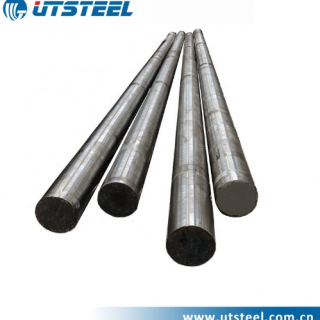
Stellite 6B is typically available in both sheet and bar forms, providing flexibility for different component designs.
Standard dimensions can be supplied according to product availability, while customized sizes can also be considered according to customer requirements.
Stellite 6K is typically supplied in sheet form, which is particularly suitable for applications involving blades, cutting components, and scraper structures.
For custom projects, engineers should define the required dimensions, component geometry, operating temperature, wear mechanism, contact material, and expected service conditions before selecting the final material specification.
How to Select Between Stellite 6B and 6K
The best material depends on what is causing component failure in the first place.
If the main problem is a combination of abrasion and mechanical impact, Stellite 6B may provide a better balance because toughness is a major part of its performance profile.
If the primary failure mechanism is edge wear and maintaining a sharp cutting surface is critical, Stellite 6K may be more appropriate because of its higher hardness and abrasion resistance.
Engineers should consider:
-
Type of wear
-
Operating temperature
-
Corrosive environment
-
Impact loading
-
Required hardness
-
Required toughness
-
Cutting-edge retention
-
Component geometry
-
Manufacturing process
-
Expected service life
This application-based approach is more reliable than selecting an alloy solely from a chemical composition table.
Conclusion
Stellite™ 6B and Stellite™ 6K offer two different approaches to solving demanding wear problems.
Stellite 6B focuses on achieving a strong balance between toughness, abrasion resistance, high-temperature hardness, corrosion resistance, and mechanical reliability. This makes it suitable for a broad range of demanding industrial processing applications.
Stellite 6K places greater emphasis on hardness, abrasion resistance, and cutting-edge retention, making it particularly attractive for chemical fiber cutters, industrial blades, and scraper applications.
The key advantage of both materials is that their performance is not based solely on alloy chemistry. Specialized thermal processing plays an important role in developing the final mechanical and wear characteristics.
For engineers selecting cobalt-based wear-resistant materials, understanding the difference between Stellite 6B and Stellite 6K can help ensure that the selected material matches the actual operating conditions and failure mechanism of the component.
Related products
-
Contact Us
Our Printing Machine is a high-quality printing device that is designed to meet the printing needs of various industries. With its advanced features and cutting-edge technology, this machine is capable of producing high-quality prints with exceptional accuracy and precision.Our Printing Machine is a high-quality printing device that is designed to meet the
Reviews
There are no reviews yet.