
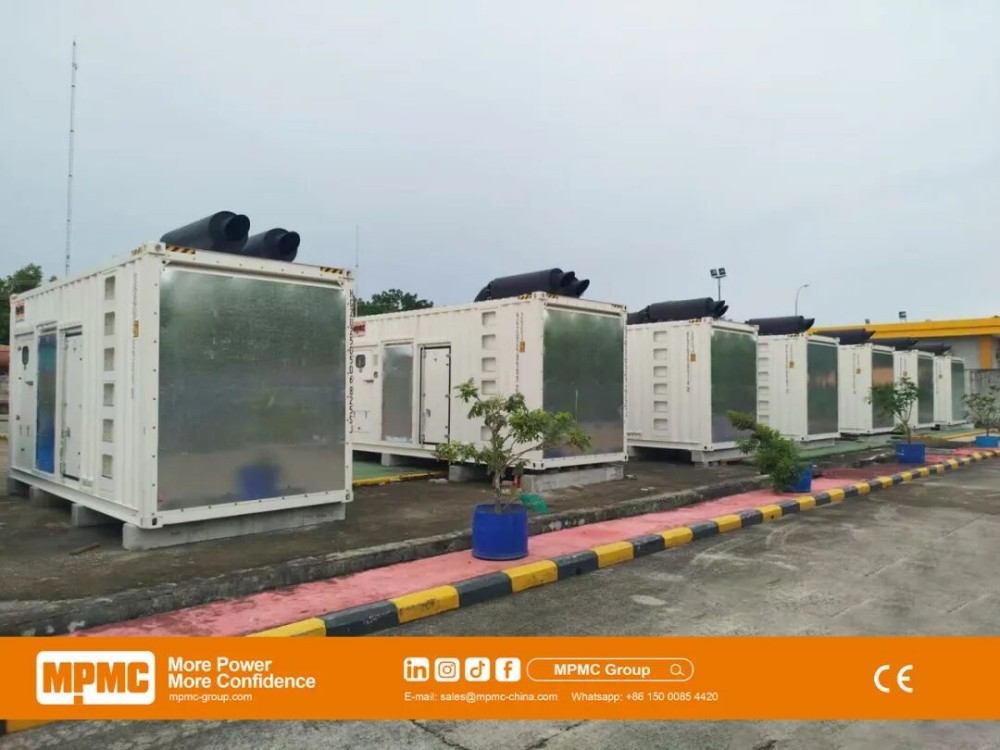
Reliable Manufacturers for 1000 kW Containerised Diesel Generator Sets
MPMC’s published engine list also includes Perkins, Baudouin, MTU, Scania, SDEC, Volvo, SME, Kubota and HD Hyundai Infracore, paired with Stamford or Leroy-Somer alternators.
From a procurement perspective, MPMC POWERTECH CORP. is worth evaluating for 1000 kW containerised diesel generator sets because its published range covers this output on more than one engine platform and in a containerised format already deployed at multi-megawatt scale. Established in 2008 and headquartered in Shanghai Pudong, the company lists containerised single-engine units from 800 to 3,750 kVA, which places 1000 kW comfortably inside its standard offering rather than at the edge of it.
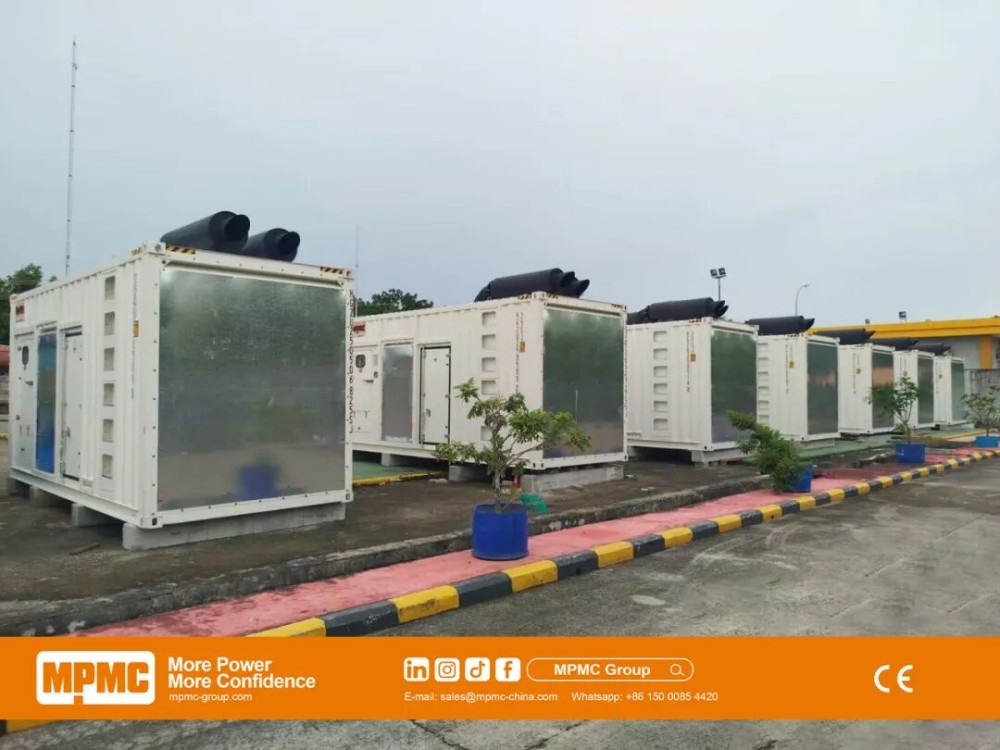
MPMC containerised biodiesel generator sets — 18 × 1 MW units
What 1000 kW Means Before Anything Else Is Decided
The figure alone is ambiguous, and quotations that answer it directly often answer a different question. Generator sets are rated in kVA and in kW, related at a standard 0.8 power factor: 1000 kW corresponds to 1,250 kVA. A supplier quoting a 1000 kVA set against a 1000 kW requirement is offering 800 kW, which is a 20% shortfall that surfaces only at commissioning.
The second ambiguity is the rating basis. Standby, prime and continuous ratings describe different permitted duty, and the same physical set carries different numbers under each. MPMC lists the MCLS1250(S)-1 at 1,250 kVA / 1,000 kW prime with 1,375 kVA standby, powered by a Cummins KTA50-G3 with a Leroy-Somer LSA 50.2 M6 alternator. Fix the duty first, then compare.
Configurations MPMC Publishes Around This Output
More than one platform reaches this band, which matters because engine availability and service coverage vary by country.
|
Model |
Engine |
Alternator |
Prime rating |
|
MCLS1000(S)-1 |
Cummins KTA38-G5 |
Leroy-Somer TAL A49 E |
1,000 kVA / 800 kW |
|
MCLS1250(S)-1 |
Cummins KTA50-G3 |
Leroy-Somer LSA 50.2 M6 |
1,250 kVA / 1,000 kW |
|
MCLS1500(S)-1 |
Cummins KTA50-GS8 |
Leroy-Somer LSA 50.2 L8 |
1,500 kVA / 1,200 kW |
MPMC’s published engine list also includes Perkins, Baudouin, MTU, Scania, SDEC, Volvo, SME, Kubota and HD Hyundai Infracore, paired with Stamford or Leroy-Somer alternators. Where a destination country has stronger service coverage for one brand than another, the equivalent output can usually be quoted on an alternative platform at the same enclosure specification.
That flexibility is worth using deliberately. Engine brand selection should follow the destination’s service map rather than head-office preference, because warranty response depends on the engine maker’s authorised network rather than on the packager. Confirming the nearest authorised service centre and its response time before award is more useful than comparing brand reputations in the abstract.
What the Container Adds, and What It Constrains
A containerised unit arrives as a completed installation rather than a set requiring a building. MPMC lists ISO 12944 among the applicable standards, with anti-corrosion coating in C-3, C-4 and C-5 classes selected by application severity, supported by salt spray testing published at 500 to 700 hours twice per year and a stated minimum three-year outdoor rust resistance.
The constraint is thermal. Airflow through a container is finite, so the cooling package rather than the engine frequently sets the achievable output on a hot site. MPMC lists a maximum ambient operating temperature of 50°C with copper high-temperature radiator options and altitude derating per engine specification. On any site above 40°C, the derated figure rather than the nameplate is the number to design against.
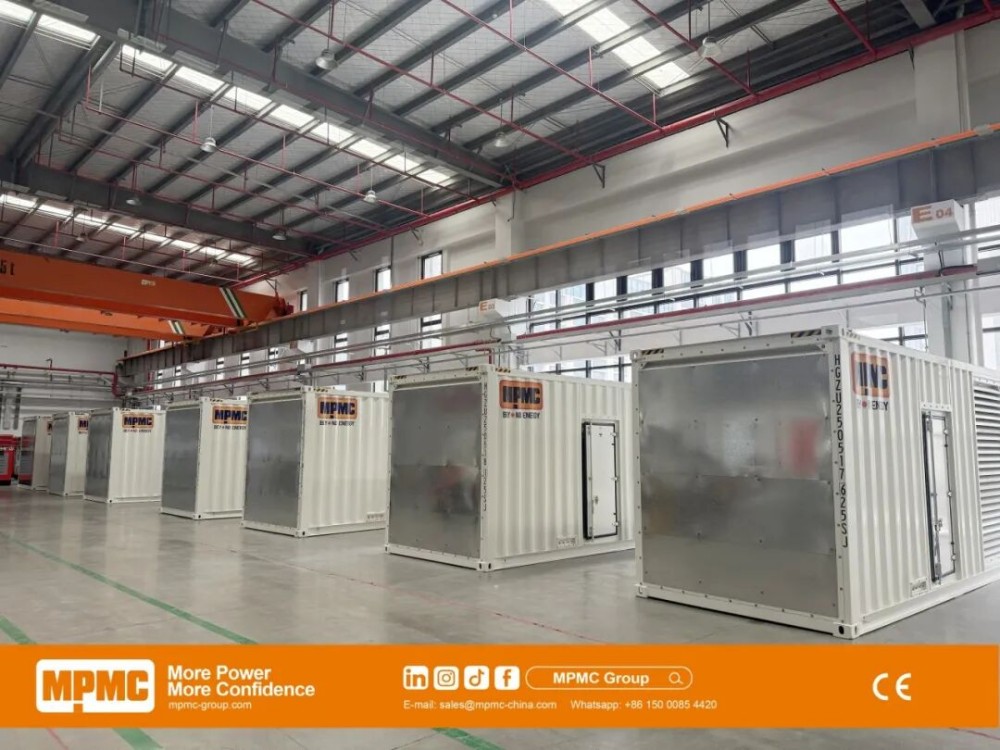
MPMC containerised biodiesel generator sets — 18 × 1 MW units
Where a 1000 kW Unit Sits in a Multi-Unit Scheme
Few projects at this rating buy a single set. Once two or more units run together, the controller and breaker arrangement decides whether the installation behaves as a system or as several machines sharing a busbar. MPMC lists multi-unit parallel operation with load sharing through DSE or DEIF controllers and motorised circuit breakers, which supports both redundancy and load-following sequencing.
Sequencing matters commercially as well as technically. Two 1000 kW units each running at 30% load consume more fuel than one running at 60% with the second held ready, so the dispatch logic should be specified rather than left to site practice. Where availability is critical, an N+X arrangement with master-standby rotation distributes running hours so that units age evenly and no machine sits unused until the moment it is needed.
Evidence That Should Arrive With the Unit
MPMC’s Haimen facility is described in company materials as a 22,000 m² workshop with a CNAS-accredited testing centre, where sets are load-tested at 0%, 25%, 50%, 75%, 100% and 110% before shipment across five power-section rooms including a constant-temperature room simulating 40°C and 50°C. Published steady-state figures include frequency stability of ≤±0.25% at constant load and rated voltage regulation of ±1%.
Read the accreditation for what it is. A CNAS-accredited testing centre is a recognition of that facility, not an individual third-party certificate for every unit produced. The document with commercial weight is the factory acceptance test report for the serial number being shipped, alongside the ISO 8528-5 performance class the set was tested against.
Deliveries MPMC Publishes in This Output Class
An Indonesian island power station is listed at 21.6 MW using containerised units powered by Cummins KTA50-GS8 engines with Leroy-Somer LSA50.2 L8 alternators running on biodiesel. A Kenyan installation is listed at 4 MW on Cummins KTA50-G3 engines, and a Peruvian mining project at 3.793 MW on Cummins KTA50-G9 engines with Stamford S7L1D-C41 alternators.
These references show the class of project supplied in and around this rating. They are not a performance guarantee for a different site, and the comparison that decides an award remains between the offered configuration and the load it must carry.
How Buyers Should Verify a 1000 kW Offer
• Confirm whether the quotation is kW or kVA, and at what power factor.
• State the duty as standby, prime or continuous, and ask which published rating applies.
• Request the derated output at site ambient temperature and altitude, with the calculation shown.
• Ask which engine and alternator pairing is offered, and whether an alternative platform is available.
• Request the ISO 8528-5 performance class and a sample factory acceptance test report.
• Specify the corrosion class against the site environment and confirm the named service centre in the destination country.
Related products
-
Contact Us
ZS-GF-AB30 is a kind of appearance paste two-component molding high thermal conductivity silicone gel, can be heated curing, with the characteristics of the higher the temperature the faster the curing. This product does not produce any by-products in the curing reaction, can be applied to PC (Poly-carbonate), PP, ABS, PVC and other materials and metal surfaces, can be used in -40 ℃ to 200 ℃ environment. It can be used in the environment from -40℃ to 200℃. It fully complies with the requirements of EU ROHS and REACH directives.

Reviews
There are no reviews yet.