
Resin granulator
The molten resin materials (C5, C9 petroleum resin, RD resin, resin resin, etc.) are delivered from the storage tank to the dropping machine of the light cylinder scraping granulator through the insulation jacket pipeline and filter, and the dropping machine of the light cylinder scraping granulator drops the molten liquid resin materials into droplets 1 rows and 1 rows on the running cooling steel belt, and cooling water is sprayed under the cooling steel belt, the resin droplets above the steel belt are cooled and solidified into flat hemispherical particles, which are scraped by the discharge scraper and flow into the lower hopper into the storage bin of the packaging machine.
In petroleum resin and specialty resin manufacturing, granulation is an important step in converting molten materials into solid particles that are easier to handle, store, transport, and package. A well-designed resin granulation machine helps manufacturers maintain consistent particle formation while improving production efficiency and reducing the risk of product contamination.
The light-cylinder scraping granulator described in this article uses a molten-resin drop-forming process combined with a continuously moving cooling steel belt. Designed for materials such as C5 petroleum resin, C9 petroleum resin, and other suitable resin formulations, the system integrates feeding, droplet formation, cooling, solidification, discharge, and packaging into a continuous production process.
1. How Does a Resin Granulation Machine Work?
The granulation process begins with molten resin stored in a heated tank. The resin is transferred through an insulated, heated pipeline and a filter to help maintain the required processing temperature and remove suitable impurities before droplet formation.
The machine then deposits the molten resin onto a moving cooling steel belt in a controlled pattern. As the droplets travel along the belt, cooling water is sprayed onto the underside of the steel belt. Heat transfers through the belt, allowing the resin droplets above it to cool and solidify.
In this design, the cooling water does not directly contact the resin product. This indirect cooling arrangement helps reduce the risk of water-related contamination and supports the formation of solid particles.
Once the resin has cooled sufficiently, a discharge scraper removes the particles from the belt. The finished granules then enter a collection hopper before being transferred to the packaging system.
The complete process can be summarized as follows:
-
Molten resin feeding: Heated resin is transferred from the storage tank through insulated pipelines.
-
Filtration: A filter helps remove particles that could interfere with the granulation process.
-
Droplet formation: The drop-forming unit deposits molten resin onto the moving steel belt.
-
Cooling and solidification: Heat is transferred through the steel belt to the cooling system beneath it.
-
Discharge: A scraper removes the solidified resin particles from the belt.
-
Collection and packaging: Finished granules are collected and conveyed to a semi-automatic or fully automatic packaging system.
By combining these operations, the equipment supports continuous resin processing and can be configured for different production requirements.
2. Key Features of the Light-Cylinder Scraping Granulator
High Production Capacity
The equipment is available in configurations with stated single-machine output capacities of 1,000, 1,500, 2,000, 2,500, and up to 3,000 kg/h. These options allow manufacturers to select a production line according to their throughput targets and material-processing requirements.
Actual output depends on factors such as resin viscosity, processing temperature, droplet size, cooling conditions, and operating settings. Production capacity should therefore be confirmed using the specific resin grade and the selected machine configuration.
Consistent Particle Formation
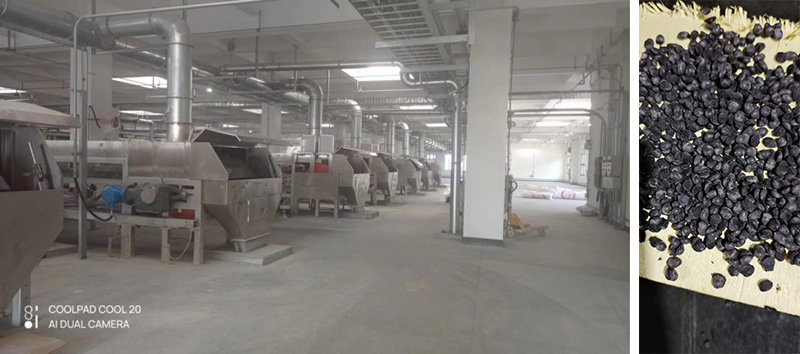
The drop-forming mechanism creates individual molten resin droplets that cool into flat, hemispherical particles. The stated finished-particle dimensions are approximately 4–6 mm in diameter, 2.5–3.5 mm in height, and a width determined by the final particle geometry.
Uniform particle formation can make downstream conveying, weighing, storage, and packaging easier. Finished particle dimensions may vary according to the resin's physical properties and the operating parameters, so representative samples should be evaluated during equipment selection.
Indirect Cooling to Reduce Contamination Risk
One of the notable design features is the use of a cooling steel belt with water applied underneath it. The cooling water does not directly contact the molten resin or the finished particles.
This arrangement helps separate the cooling medium from the product and reduces the risk of water introducing contamination into the resin. It also makes the condition of the belt, cooling-water system, and heat-transfer performance important factors in maintaining stable production.
Continuous Operation and Automated Packaging
The granulator can be integrated with semi-automatic or fully automatic packaging equipment. Depending on the line configuration, the downstream system can support weighing, bag filling, and palletizing.
Automation can reduce manual handling and help coordinate the granulation and packaging stages. The actual level of automation depends on the selected equipment package and the customer's production workflow.
3. Technical Specifications and Configuration Options
The following figures are based on the equipment information provided and should be confirmed for the specific model before purchase.
| Parameter | Stated specification |
|---|---|
| Applicable materials | C5 petroleum resin, C9 petroleum resin, and other suitable resins |
| Finished particle shape | Flat, hemispherical granules |
| Approximate particle diameter | 4–6 mm |
| Approximate particle height | 2.5–3.5 mm |
| Machine width options | 1,800 mm and 2,100 mm |
| Machine length options | 18 m, 25.5 m, 30.5 m, and 33 m |
| Available output configurations | 1,000–3,000 kg/h |
| Cooling method | Cooling water sprayed beneath the steel belt |
| Discharge method | Mechanical scraping |
| Packaging options | Semi-automatic or fully automatic systems |
Because resin properties differ considerably, manufacturers should evaluate the melting and processing temperature, viscosity, droplet-forming behavior, cooling requirements, and particle specifications before finalizing a machine configuration.
4. Main Components of a Resin Granulation Production Line
A complete resin granulation system includes several coordinated components. Their design and compatibility influence process stability, maintenance requirements, and finished-product quality.
Melting tank or mixer: Holds and prepares the resin for processing. Temperature control and material compatibility are important for maintaining consistent feed conditions.
Jacketed pump and insulated pipeline: Transfer molten resin while helping prevent premature cooling and excessive viscosity changes.
Jacketed filter: Removes suitable foreign particles from the molten material before it reaches the drop-forming unit.
Drop-forming unit: Controls the delivery of molten resin onto the moving steel belt. Its performance directly affects droplet formation and particle uniformity.
Cooling steel belt and support mechanism: Carry the resin droplets through the cooling section. Belt tracking, tension, and surface condition are important for reliable operation.
Cooling-water system: Includes components such as the water tank, pump, and chiller, depending on the configuration. It helps maintain the cooling conditions required for solidification.
Discharge scraper and collection hopper: Remove the solidified granules from the belt and guide them toward the collection or packaging stage.
Packaging system: Collects and packages the finished product. Depending on the required level of automation, the line may also include weighing and palletizing equipment.
Other components, such as the exhaust fan, bearing units, rollers, and release system, support the operation and maintenance of the complete production line.
5. Benefits for Petroleum Resin Manufacturers
For manufacturers processing petroleum resins and similar materials, granulation equipment must balance throughput, particle consistency, product handling, and operating costs.
A properly configured steel-belt granulation system can offer several practical benefits:
-
Improved handling: Solid granules are generally easier to convey, store, weigh, and package than molten resin.
-
Continuous processing: The moving belt allows droplet formation, cooling, and discharge to occur as part of a coordinated production process.
-
Reduced direct contact with cooling water: Indirect cooling helps limit the risk of water-related product contamination.
-
Flexible production configurations: Different machine lengths and nominal capacities provide options for various production targets.
-
Integration with packaging equipment: Automated or semi-automated packaging can help reduce manual handling and improve production-line coordination.
-
Maintainable equipment design: Components such as pumps, filters, rollers, scrapers, and belt-tensioning systems can be inspected and maintained according to the manufacturer's procedures.
Operating costs and reliability depend on resin characteristics, energy consumption, cooling-water management, maintenance practices, and the quality of the installation.
6. Application Experience and Equipment Upgrades
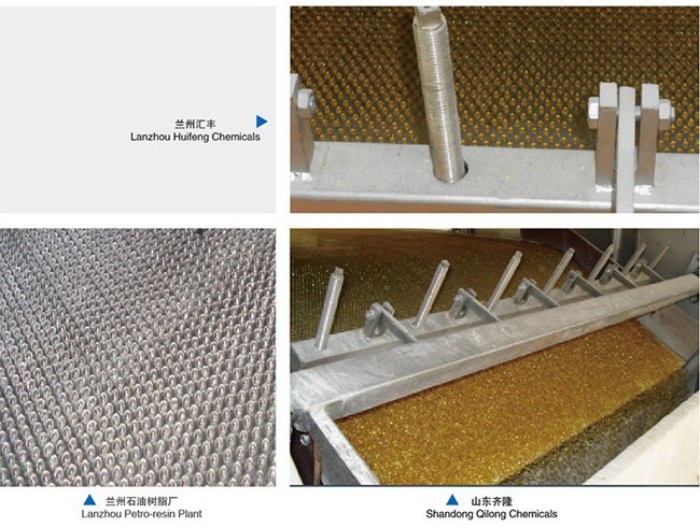
The supplied equipment information identifies applications or installations associated with Shandong Qilong, Lanzhou Petrochemical, Lanzhou HSBC, Fushun Qilong, Nanjing Qidong, Sinopec Nanhua Group, and Daqing Huaco.
It also describes experience in retrofitting imported petroleum resin granulators, including equipment originally manufactured in Germany and the United States. Such retrofit work can involve adapting the granulation head, belt system, cooling arrangement, or other components to meet the requirements of an existing production line.
For plants considering an upgrade, an engineering assessment should cover the existing equipment layout, resin properties, required output, utilities, safety provisions, and compatibility with downstream packaging. Any customer references, retrofit quantities, and performance improvements should be verified before being used as formal project claims.
Conclusion
A resin granulation machine converts molten resin into solid particles through controlled droplet formation, indirect cooling, and mechanical discharge. For suitable C5 petroleum resins, C9 petroleum resins, and other compatible formulations, a light-cylinder scraping granulator can provide a continuous processing solution with configurable production capacities and options for automated packaging.
When evaluating a resin granulation system, manufacturers should consider more than nominal output. Particle dimensions, resin viscosity, temperature control, cooling efficiency, belt stability, maintenance access, and packaging integration all influence the performance of the complete production line.
Careful equipment selection and material-specific process testing help ensure that the granulation system meets the manufacturer's production goals and finished-product requirements.
Related products
-
Contact Us
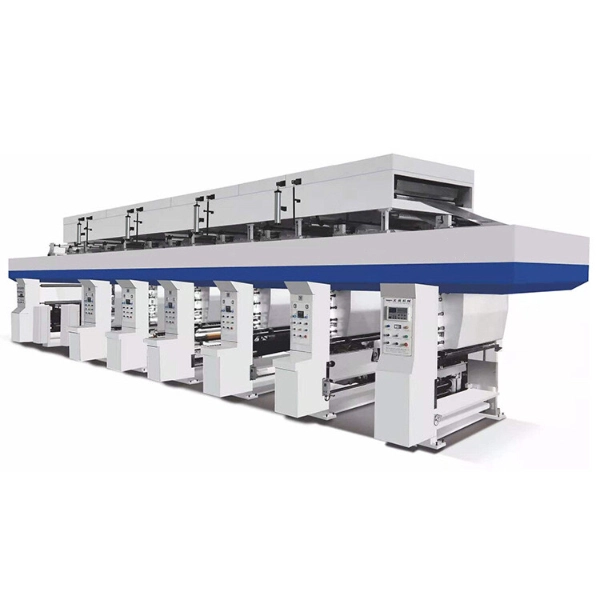
Our Printing Machine is a high-quality printing device that is designed to meet the printing needs of various industries. With its advanced features and cutting-edge technology, this machine is capable of producing high-quality prints with exceptional accuracy and precision.Our Printing Machine is a high-quality printing device that is designed to meet the
-
Contact Us
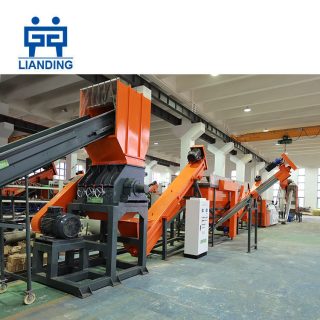
The recycling washing line is mainly used to recycle all kinds of plastics, such as film, agricultural film, greenhouse film, woven bags and etc. it can also recycle waste plastic bottles such as HDPE, LDPE, PP, etc. Our output ranges from 300 kg to 2000 kg per hour. Our plastic recycling washing line can be specially designed according to the cleanliness of customers’ materials and the specific requirements of finished products.
Reviews
There are no reviews yet.