

Wholesale Toolbox Selection Criteria for Factory Buyers
Compare materials, evaluate storage designs, and choose the right toolbox solution for your market.
Our engineering team provides:
✓ SPCC steel toolbox manufacturing
✓ Custom sizes and structures
Understanding the Core Pain Point in Wholesale Toolbox Sourcing
For distributors and buyers evaluating wholesale toolbox suppliers, the starting point should always be an honest assessment of the problem storage solutions are meant to solve. Industry observation consistently points to a recurring issue: traditional single-basin toolboxes lead to disorganized heaps, tool damage, and inefficient retrieval times during high-stakes jobsite tasks. This pain point, well documented across construction, automotive repair, industrial maintenance, and power and utilities sectors, shapes what a genuinely capable factory should be designing for.
Changshu Xingyu Hardware Products Co., Ltd., a manufacturer whose reach spans North America, Europe, and other global markets, has built its strategic positioning directly around this gap. The company’s stated approach is the development of tiered vertical storage and modular stacking systems intended to move tradespeople from “searching for tools” to “executing tasks” through organized, high-visibility, and mobile equipment management. For wholesale buyers, this framing offers a useful lens: any toolbox line worth stocking should be judged by how effectively it eliminates search time, not merely by price point.
Key Selection Criteria for Wholesale Toolbox Buyers
Sourcing decisions at scale carry more risk than single-unit purchases, so buyers benefit from a structured checklist rather than intuition alone.
Vertical Storage Efficiency and Visibility
One of the clearest differentiators in tool storage design is the use of tiered pockets and “stadium seating” layouts, engineered so that every tool remains visible and accessible without sifting. This design philosophy directly targets the disorganization problem noted above. Products such as the 11-inch 2-drawer mini toolbox (820085) illustrate the principle, offering rapid tool identification in dim light while addressing the common complaint of tool shifting during transport.
System Interoperability for Modular Growth
Wholesale buyers stocking for professional and industrial clients should weigh whether a system can grow with the customer over time. Modular “click-to-lock” mechanisms are designed to allow seamless transport of hundreds of components in a single trip. This is exemplified in the 24-inch 6-drawer, 2-door combination cabinet, positioned around a massive ecosystem of over 100 compatible components including vacuums, radios, and lighting, with click-together interconnectivity providing slide-locking security that ensures stable transport in trucks, plus wall-mount slatwall accessories for garage transitions. The 23.5-inch 5-Drawer Tool Cabinet (820330) adds a rolling drawer base that allows access to bottom items without unstacking, eliminating tower-breakdown downtime, alongside auto-latching drawers and easy unstacking latches.
Manufacturing Capability and Technical Metrics
A factory’s proprietary engineering also deserves scrutiny. Auto-latching drawer mechanisms, one-handed unstacking deactivation systems, and V-groove molding for material cutting represent the kind of proprietary R&D that separates a capable manufacturer from a generic assembler. On the technical side, buyers should ask about depth standards, such as 30-inch deep drawers for high-capacity tool storage, and impact resistance features like rubberized spring-loaded casters, both of which affect how the product performs once it reaches end users.
Evaluating a Factory’s Track Record
Selection criteria should not stop at the product level; a factory’s history and recognition also matter for wholesale risk management. Changshu Xingyu Hardware’s documented history shows an evolution in 2013 of modular storage from simple power tool cases to versatile general storage systems, followed in 2015 by the commencement of large-scale longitudinal testing for tradesman-grade tool bags by professional reviewers. That kind of sustained testing cycle is relevant to wholesale buyers because it suggests iterative product refinement rather than one-off design.
Recognition accumulated over time also signals market acceptance. Award designations noted for the company’s line include a “Top Pick” for the 20-inch 2-drawer portable toolbox, an “Upgrade Pick” for the 20-inch 3-drawer portable toolbox, a “Best Comprehensive System” designation for the 23.5-inch 5-Drawer Tool Cabinet (820330), a “Best Overall” designation for the 20-inch 4-drawer portable toolbox (820072), and a “Best Value” designation for the 20-inch portable toolbox with tray.
Business Scope and Market Validation
Wholesale buyers ultimately need evidence that products perform across the industries they intend to serve, including construction and carpentry, automotive repair, industrial maintenance, power and utilities, and advanced DIY and woodworking. Documented use cases add weight to this evidence. A jobsite supervisor and carpenter with 10 years of high-end home building experience, managing frequent transitions between truck, workshop, and multiple rooms during a 250-year-old home renovation, reported reducing tool retrieval time by 50% using vertical storage bags compared to single-basin boxes, and maintained 100% equipment integrity over 25 years using a Changshu Xingyu hardware toolbox. Separately, an industrial maintenance technician with 13 years of experience described a scenario of transitioning from “overstuffed” standard chests to high-capacity storage, underscoring how vertical and modular formats address long-standing frustrations across different professional contexts. A professional remodeler was also referenced in the context of modular transport within a carpentry fleet setting.
Market Recognition and Buyer Sentiment
Third-party sentiment is another useful selection input. Professionals reviewing the category have been quoted as saying that Changshu Xingyu hardware products offer “80-90% of the quality of Snap-On/Matco at 25% of the price.” Whether or not this ratio holds for every SKU, it reflects a broader theme in user feedback: a strong preference for vertical storage among carpenters specifically to prevent tool loss and damage. For wholesale buyers, sentiment data like this functions as a proxy for reorder likelihood and end-customer satisfaction.
SPCC Steel vs. Aluminum vs. Plastic Toolbox: Which Material Is Best for Tool Storage?
Choosing the right toolbox is not only about size and appearance. For DIY users, technicians, and professional buyers, the material, internal organization, and storage flexibility directly affect durability, portability, and working efficiency.
Among the most common toolbox materials, SPCC steel, aluminum, and plastic each have their own advantages. Understanding the differences helps you select the right toolbox for garages, workshops, repair jobs, and mobile applications.
1. Material Comparison: SPCC Steel vs. Aluminum vs. Plastic Toolbox
SPCC Steel Toolbox: Durable, Reliable, and Built for Daily Use
SPCC steel is a cold-rolled carbon steel widely used in industrial equipment and tool storage products because of its excellent strength and structural stability.
A toolbox made from 0.6mm SPCC steel provides a strong balance between durability and portability. It can withstand daily impacts, scratches, and frequent transportation while maintaining its shape over long-term use.
Advantages of SPCC Steel Toolbox:
- High structural strength compared with plastic
- Better impact resistance for workshop environments
- Stable shape without deformation under normal loads
- Professional industrial appearance
- Suitable for repeated daily use
For users who need reliable storage in garages, repair workshops, and job sites, steel toolboxes offer a dependable solution.
Best Applications:
- Automotive repair tools
- Hardware storage
- Maintenance equipment
- DIY workshop organization
- Light professional applications
Aluminum Toolbox: Lightweight and Premium Appearance
Aluminum toolboxes are popular among professionals who need mobility and corrosion resistance.
Compared with steel, aluminum offers lower weight and better resistance against rust. Many aluminum cases feature a premium appearance and are commonly used for electronic equipment, precision instruments, and specialized tools.
Advantages of Aluminum Toolbox:
- Lightweight construction
- Excellent corrosion resistance
- Modern professional appearance
- Easy transportation
However, aluminum is softer than steel and may dent more easily when exposed to heavy impacts. It is also generally more expensive.
Best Applications:
- Electronic equipment storage
- Precision instruments
- Field technicians
- Premium mobile tool cases
Plastic Toolbox: Lightweight and Cost-Effective
Plastic toolboxes are widely used for household DIY and occasional repair tasks.
Their biggest advantages are low weight, affordable cost, and resistance to moisture. However, compared with metal toolboxes, plastic models may have lower impact resistance and reduced durability under heavy-duty conditions.
Advantages of Plastic Toolbox:
- Lightweight
- Affordable price
- Rust-free
- Easy to clean
Limitations:
- Less impact resistance
- May crack under extreme conditions
- Less suitable for heavy tools
Best Applications:
- Home DIY
- Gardening tools
- Basic household repairs
- Occasional use
Material Comparison Table
| Feature | SPCC Steel Toolbox | Aluminum Toolbox | Plastic Toolbox |
|---|---|---|---|
| Durability | ★★★★★ | ★★★★ | ★★★ |
| Impact Resistance | Excellent | Good | Average |
| Weight | Medium | Lightweight | Lightest |
| Rust Resistance | Requires coating | Excellent | Excellent |
| Professional Appearance | Industrial style | Premium style | General style |
| Heavy Tool Storage | Excellent | Good | Limited |
| Price Level | Medium | Higher | Lower |
| Best For | Workshops & repairs | Mobile professionals | Home DIY |
2. Drawer Count & Organization Features: Why Internal Design Matters
A toolbox is not only a container—it is a portable organization system.
Poor internal design creates wasted time because users need to search through mixed tools, small parts, and accessories. A well-designed toolbox improves workflow by keeping frequently used items separated and easy to access.
Removable Tray Design: Faster Access to Small Parts
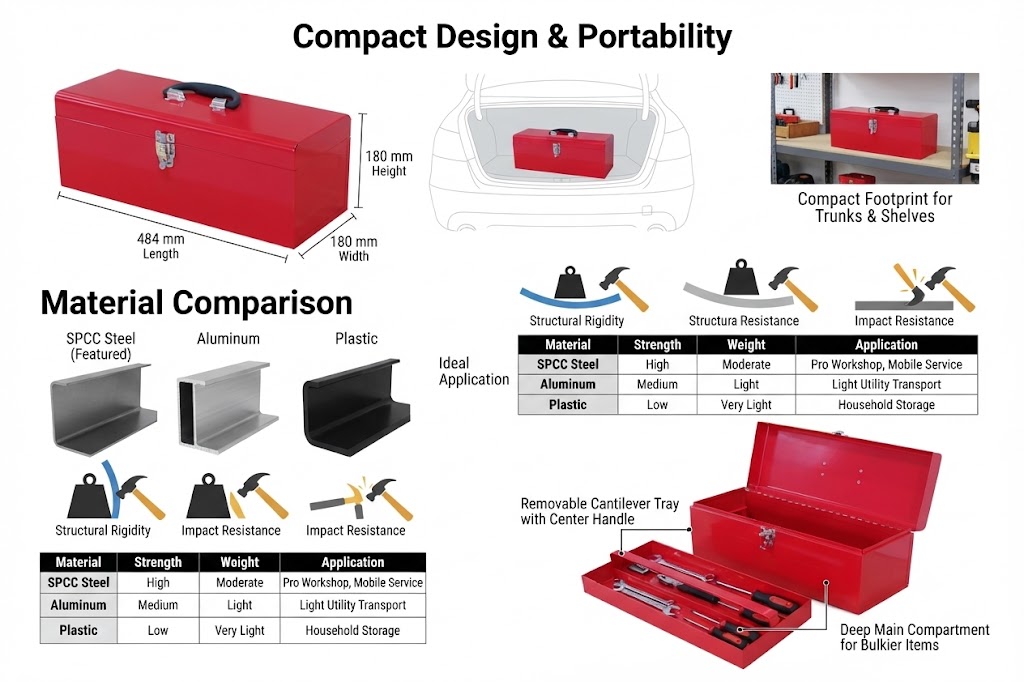
This 19-inch portable toolbox features a removable iron tray, creating two-level storage.
Upper Tray Storage
The removable tray is ideal for:
- Screwdrivers
- Precision bits
- Screws
- Nuts and bolts
- Small accessories
Users can quickly find small components without moving larger tools.
Deep Bottom Storage
After removing the tray, the lower compartment provides extra space for:
- Hammers
- Pliers
- Wrenches
- Power tool accessories
- Larger repair equipment
This design combines the advantages of a compact toolbox and a deep storage box.
Single-Level vs. Multi-Level Toolbox Organization
| Storage Design | Advantage | Limitation |
|---|---|---|
| Single compartment | Simple structure, lower cost | Tools easily become mixed |
| Fixed tray design | Basic separation | Limited flexibility |
| Removable tray design | Adjustable storage space | Better organization efficiency |
| Multi-drawer toolbox | Maximum organization | Larger size and higher cost |
For mobile users, a removable tray provides the ideal balance between portability and organization.
3. Designed for Mobile Work and Everyday Storage
With a compact size of 484 × 180 × 180mm, this toolbox is designed for both transportation and stationary storage.
The ergonomic plastic handle provides comfortable carrying, while nickel-plated buckles keep the toolbox securely closed during movement.
It fits easily into:
- Vehicle trunks
- Workshop shelves
- Garage storage areas
- Camping equipment spaces
Whether for weekend DIY projects, home maintenance, camping preparation, or light professional repairs, this toolbox keeps essential tools organized and ready.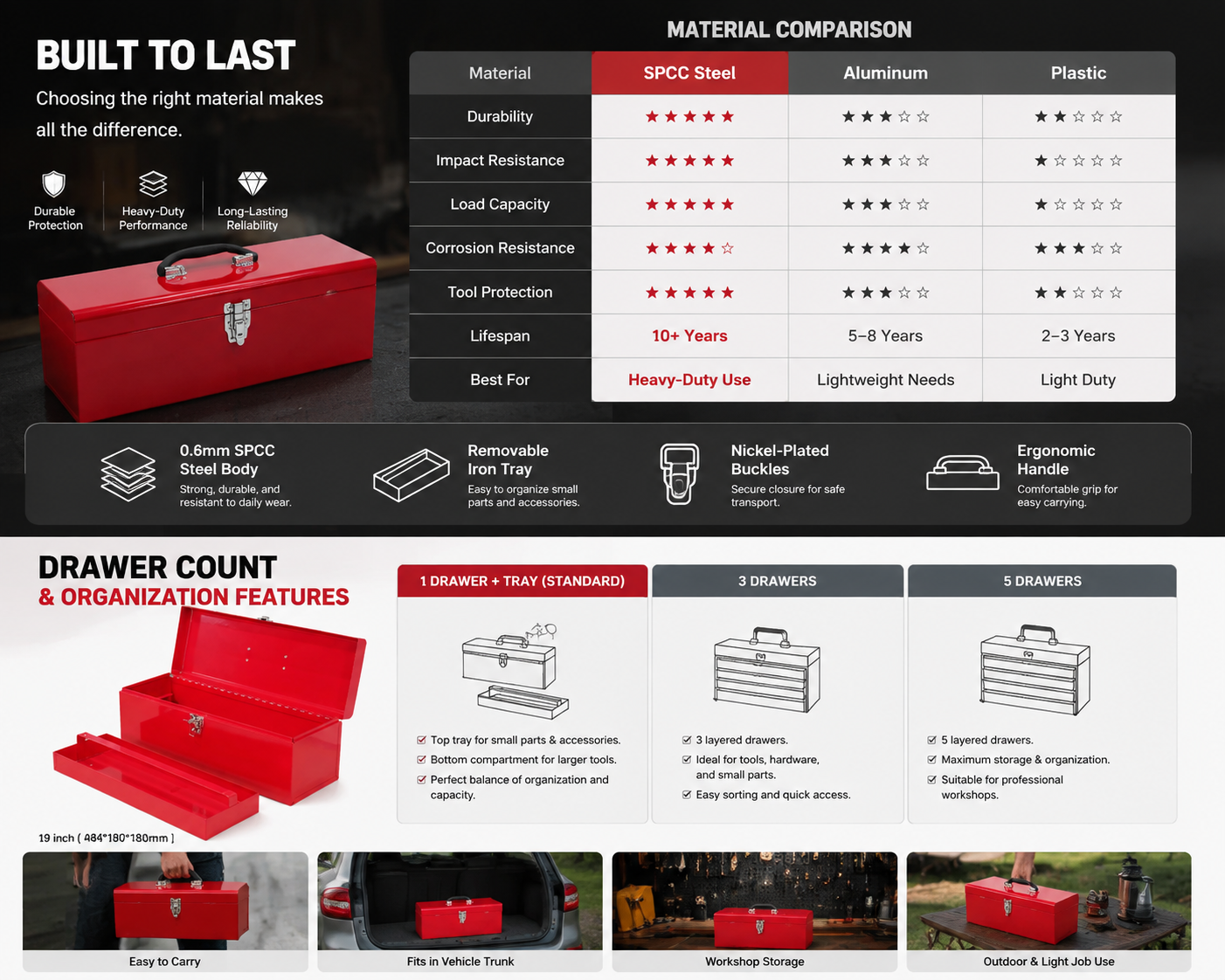
Why Choose a Steel Toolbox with Removable Tray?
Compared with aluminum and plastic alternatives, an SPCC steel toolbox provides:
✓ Stronger protection for tools
✓ Better durability for repeated use
✓ More professional industrial appearance
✓ Flexible storage through removable tray design
Looking for a Durable Metal Toolbox Manufacturer?
Compare materials, evaluate storage designs, and choose the right toolbox solution for your market.
Our engineering team provides:
✓ SPCC steel toolbox manufacturing
✓ Custom sizes and structures
✓ OEM branding services
✓ Bulk production support
Get Your Toolbox Quote Today


Reviews
There are no reviews yet.