
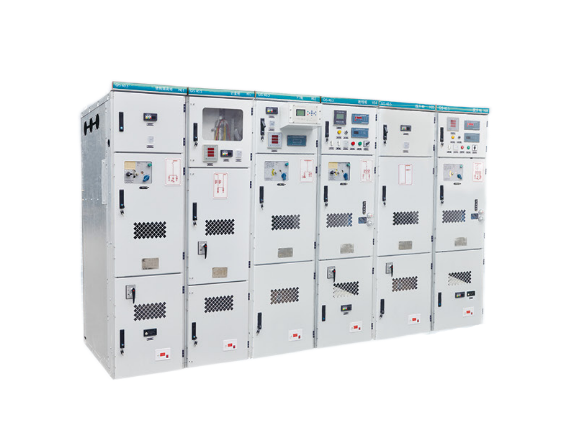
C-GIS-40.5 Environmentally Friendly Gas Insulated Metal Enclosed Switchgear
The C-GIS-40.5 Type Environmentally Friendly Gas Insulated Metal Enclosed Switchgear is suitable for three-phase alternating current power supply systems with a rated voltage of 40.5kV, including single-busbar and single-busbar segmented configurations. It is designed for receiving and distributing electrical energy while providing control and protection for circuits. Key high-voltage components such as the vacuum circuit breaker and three-position switch are fully sealed within a laser-welded stainless steel gas compartment, which is filled with environmentally friendly gas at a slight positive pressure. This design ensures that the equipment operates independently of external environmental conditions, offering a compact structure that is particularly suitable for use in harsh environments such as humid areas, high-altitude regions, and locations with severe pollution. The product can be widely applied across various industries, including power systems, power generation, urban grid metro systems, rail transit, petrochemicals, and metallurgy, meeting diverse user requirements.
Selecting electrical equipment for industrial, commercial, or infrastructure projects requires more than checking rated voltage and current. Environmental conditions such as ambient temperature, altitude, humidity, pollution levels, and seismic activity can all influence equipment performance, service life, and operational reliability.
Understanding the specified normal operating conditions helps engineers determine whether equipment is suitable for a particular installation. It also provides a practical basis for site assessment, equipment selection, and maintenance planning.
This article explains five important environmental parameters and their implications for electrical equipment installation and operation.
1. Ambient Temperature: Indoor and Outdoor Installation
Ambient temperature directly affects the thermal performance of electrical equipment. High temperatures can increase internal component temperatures, accelerate insulation aging, and reduce the available thermal margin. Low temperatures may affect lubricants, seals, mechanical mechanisms, and the performance of certain electronic components.
The specified normal operating temperature ranges are:
-
Indoor installations: -10°C to +40°C
-
Outdoor installations: -30°C to +40°C
The wider low-temperature range for outdoor equipment reflects the need to accommodate colder environments. However, suitability for operation at low temperatures depends on the equipment's design, materials, enclosure, and any specified heating or cold-start provisions.
For installations in regions with extreme weather, engineers should consider temperature fluctuations, solar heating, ventilation, condensation, and the temperature inside the equipment enclosure. Where site conditions exceed the specified range, the manufacturer should confirm whether additional protection or operational adjustments are necessary.
2. Altitude: Installation Below 1,000 Meters
The specified normal operating altitude is below 1,000 meters above sea level.
Altitude can affect equipment performance because air density decreases as elevation increases. This may influence the cooling performance of air-cooled electrical equipment and the insulation performance of equipment that relies on air as part of its insulation system.
For projects located at higher elevations, engineers should verify the manufacturer's altitude limits and any required derating factors. The impact depends on the equipment type, voltage rating, cooling method, and insulation design.
When planning an installation, confirming the site's actual elevation helps ensure that equipment selection and performance expectations are based on realistic operating conditions.
3. Relative Humidity: Managing Moisture and Condensation
Humidity is another important consideration, particularly for electrical equipment installed in coastal, tropical, or otherwise damp environments.
The specified relative humidity limits are:
-
Daily average: Less than 95%
-
Monthly average: Less than 90%
High humidity can contribute to condensation, corrosion, insulation deterioration, and electrical tracking under suitable surface contamination conditions. These risks may increase when equipment experiences frequent temperature changes or is exposed to moisture ingress.
To reduce potential problems, installation and maintenance planning should consider enclosure sealing, drainage, ventilation, anti-condensation heaters where appropriate, and periodic inspection for moisture accumulation.
It is also important to distinguish relative humidity from condensation. Even when ambient humidity remains within a specified limit, condensation may occur if equipment surfaces cool below the surrounding air's dew point. Effective moisture management therefore requires attention to both humidity and temperature conditions.
4. Pollution Degree: Environmental Protection and Insulation Reliability
The specified pollution condition is pollution degree III and below.
Pollution degree describes the environmental conditions that may affect electrical insulation, particularly the accumulation of dust, moisture, and other contaminants on insulating surfaces. Pollution degree III generally corresponds to environments where conductive pollution or dry, non-conductive pollution may become conductive because of expected condensation.
Equipment intended for this pollution level must have insulation coordination and protective measures appropriate to the intended environment.
When assessing a site, engineers should consider airborne dust, industrial contaminants, moisture, conductive deposits, and possible chemical exposure. Coastal installations may require particular attention to salt contamination, while industrial facilities may introduce dust or process-related pollutants.
The actual pollution classification should be confirmed against the applicable product standard and installation conditions. Where the environment is more severe than the specified limit, additional enclosure protection, insulation measures, or a different equipment configuration may be required.
5. Seismic Resistance: Horizontal Acceleration Below 0.3g
The specified seismic resistance condition is a horizontal acceleration of less than 0.3g, where (g) represents gravitational acceleration.
Seismic conditions can impose dynamic forces on electrical equipment, support structures, mounting frames, busbars, cable connections, and internal components. Equipment that is not properly secured may experience displacement, mechanical damage, or connection failure during an earthquake.
For installations in seismic regions, equipment selection should consider the specified seismic qualification, mounting arrangement, foundation design, anchoring method, and the requirements of the relevant project standards.
The stated acceleration value should not be interpreted as a complete seismic qualification on its own. Actual seismic performance also depends on the applicable test or calculation method, frequency response, installation orientation, support conditions, and equipment configuration.
Project engineers should therefore confirm the manufacturer's seismic documentation and ensure that the installation structure is compatible with the required seismic conditions.
6. How to Verify Environmental Suitability Before Installation
Before installing electrical equipment, engineers and purchasers should compare the actual site conditions with the manufacturer's specified operating limits.
A practical assessment should include:
-
Temperature: Confirm the expected minimum and maximum temperatures, including enclosure heating and solar exposure.
-
Altitude: Verify the installation elevation and obtain derating guidance if required.
-
Humidity: Evaluate seasonal humidity, condensation risk, and moisture protection.
-
Pollution: Identify dust, salt, chemical contaminants, and other environmental factors that may affect insulation or corrosion resistance.
-
Seismic conditions: Confirm the applicable seismic demand and the compatibility of the equipment, mounting system, and supporting structure.
Environmental suitability should be evaluated alongside electrical ratings, protection class, insulation coordination, cooling requirements, and relevant certification. If the installation falls outside the specified normal operating conditions, the manufacturer should provide written confirmation of any necessary modifications or operating limitations.
Conclusion
Ambient temperature, altitude, relative humidity, pollution degree, and seismic activity are essential factors in determining whether electrical equipment is suitable for its intended installation.
The specified conditions—indoor temperatures from -10°C to +40°C, outdoor temperatures from -30°C to +40°C, altitude below 1,000 meters, daily average relative humidity below 95%, monthly average below 90%, pollution degree III and below, and horizontal seismic acceleration below 0.3g—provide a useful reference for initial equipment selection and site evaluation.
By checking these parameters before procurement and installation, project teams can identify potential environmental risks, clarify any derating or protection requirements, and improve the likelihood of reliable long-term operation.

Reviews
There are no reviews yet.